Saturday, 29 August 2026

Deep Down, Its Complicated

Deep Down, Its Complicated

A correspondent forwarded THIS LINK which is based on THIS JOURNAL ARTICLE. It concerns seismic waves created by the French nuclear tests in the South Pacific between 1977 and 1995. The records used were recorded in Kazakhstan. 

One would think that seismic waves created in one spot and recorded in another would be the same over time. After all they are travelling through the same stuff!

But no! Using waves which reflected inside the (liquid) outer core, the travel times varied over time. This leads to the conclusion that the outer core is dynamically changing. 

This is important as the outer core is responsible for generating the Earths magnetic field.

Both articles are quite complex but Google Gemini is able to give a fairly simple version of the papers. Here it is:-

-------------------------
A research study published in the Journal of Geophysical Research: Solid Earth (doi: 10.1029/2026JB033798) reveals that the deep interior of our planet is far more dynamic than long believed, challenging the traditional view that Earth’s outer core is a uniform, static ocean of liquid metal.

Led by Virginia Tech geophysicist Ying Zhou, researchers analyzed seismic data recorded during underground nuclear tests conducted by France at Moruroa Atoll in French Polynesia between 1977 and 1995. Subterranean nuclear explosions provide a unique advantage over natural earthquakes for geoscientists: because test detonations occurred at precisely known, nearly identical locations, they generated consistent seismic wave pathways through Earth’s deep interior. By analyzing 112 pairs of historic explosions, the team tracked microscopic variations in how long it took specific waves (known as PKrKP waves, which reflect within the outer core) to travel through the planet over several decades.

The findings indicate that the travel times of these deep-reaching waves changed measurably between test events. This shift points to a massive, previously unrecognized structure drifting within the molten outer core beneath the southern Pacific Ocean. Estimated to stretch roughly 700 kilometers across and 100 kilometers thick, this feature may consist of solid material suspended inside the churning liquid metal or localized density variations drifting as the core circulates.

These rapid, decade-scale shifts are significant because movement within the liquid outer core powers the geodynamo—the planet-wide engine responsible for generating Earth’s protective magnetic field. Understanding that massive structures can shift deep underground over just a few decades offers scientists a dynamic new model for how Earth’s core behaves, while demonstrating how legacy Cold War-era nuclear records can serve as unexpected time capsules for planetary science.
--------------------
Down to Earth Extra September 2026

 Down to Earth Extra September 2026

The September 2026 edition of Down to Earth Extra has been published. You can download it HERE or you can read it below.


Saturday, 8 August 2026

Down to Earth Extra August 2026

 Down to Earth Extra August 2026

The august 2026 edition of Down to Earth Extra has been published. You can down load it HERE or you can read it below.


Ichthyotitan severnensis - Finding a New Species

 Ichthyotitan severnensis - Finding a New Species

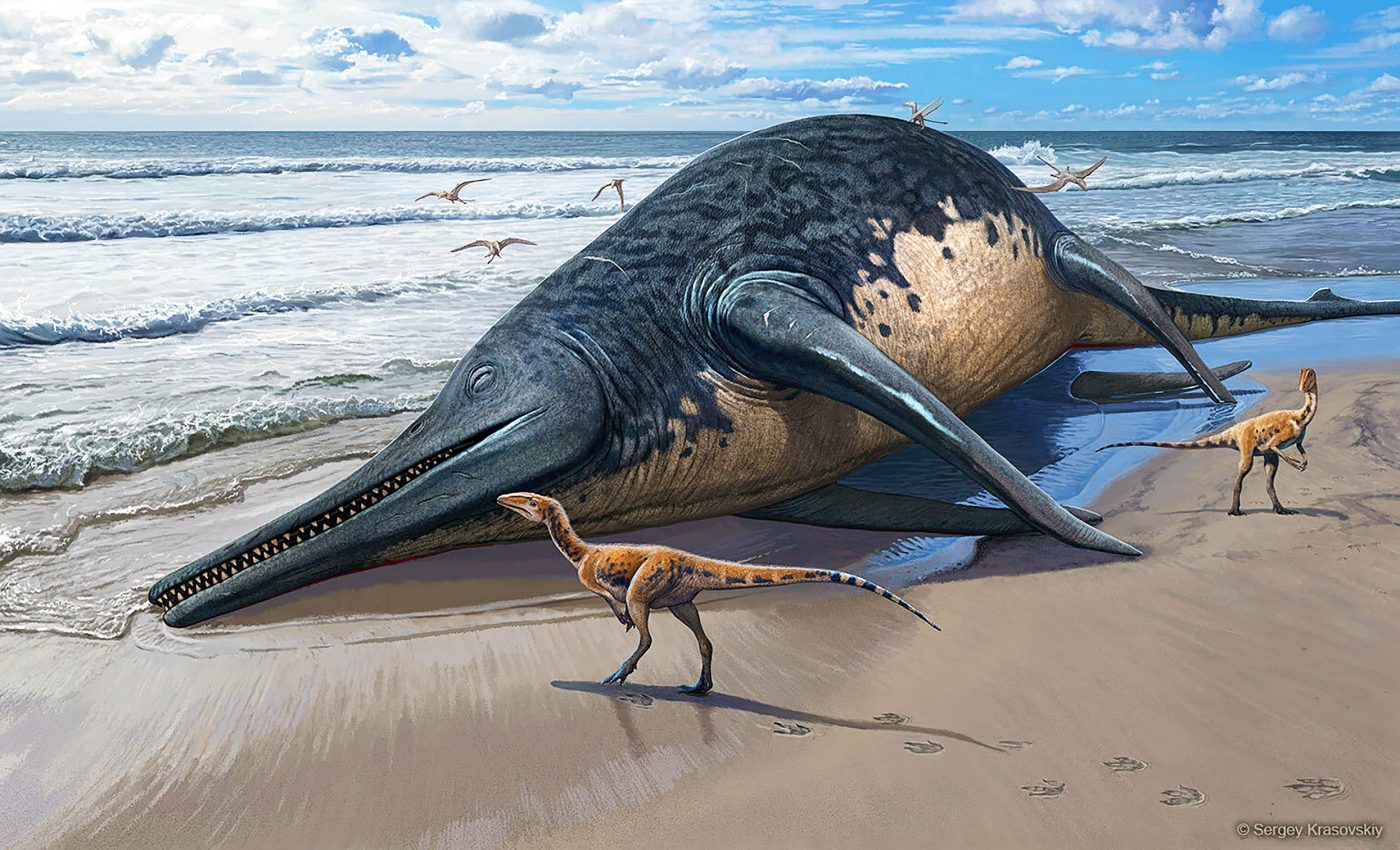
I came across this WEB PAGE and from it was directed to THIS ACADEMIC PAPER. The contrast between the styles is extreme but the basis for both is the same. This is the finding of bones from the jawbone of an ichthyosaur and using the finds to describe a huge creature and erect a new species.

The bones were found by a young girl and her father on Blue Anchor Bay in Somerset and the creature is estimated to be 25m long. It was realised that a similar jawbone had been found some time earlier in the same rock layer, at a nearby locale. This was sufficient for a new species to be postulated.


A washed-up Ichthyotitan severnensis carcass on the beach. Credit: Sergey Krasovskiy.

The story of the find shows that amateur geologists can still be important in our science. And it is cheering to note that they both appear among the authors of the academic paper.

The paper has a long description of the find and a discussion about the naming of a new species. And it asks that if you find something similar to contact them! And they would be delighted if you could find a complete specimen of the animal!

Saturday, 1 August 2026

Did Complex Life Appear Because the Magnetic Field was Weak?

 Did Complex Life Appear Because the Magnetic Field was Weak?

Some parts of the history of the Earth's magnetic field are easy to measure. But the strength of the field is not one of them. We have lots of information of the reversals of the polarity of the field and the direction of the magnetism - think of the stripes on the ocean floor and knowing the latitude of when rocks were laid down - but the field strength of the field is harder to come by.

And this is important for the presence of the field is what protects us from deadly cosmic rays. It is very possible that no field = no life.

But some measurements of field strength have been made and one of the interesting things is that it was very low in the Ediacaran. It was a fifteenth of the present value. This and the consequences of this are discussed in THIS ARTICLE.

Did the reduction in magnetic field strength allow more genetic mutation in the single-celled creatures promoting the multi-celled Ediacaran fauna?

The article goes on to discuss the mechanism which affected the field, essentially the formation of the Earth's inner core. The 100 million years this took covers the Ediacaran and the "Cambrian Explosion".

The article gives a pleasing combination of Earth physics and biology. It may even be true!