Can Volcanos be Connected?
A correspondent has sent me THIS ARTICLE. For ever geologists have thought that volcanoes could be studied in isolation but, more recently it has been discovered that magma does not just travel towards the surface but can also go sideways - it can move from one volcano to another, sometimes many kilometres apart. And, sometimes the type of rock erupted can change - which seems very odd.
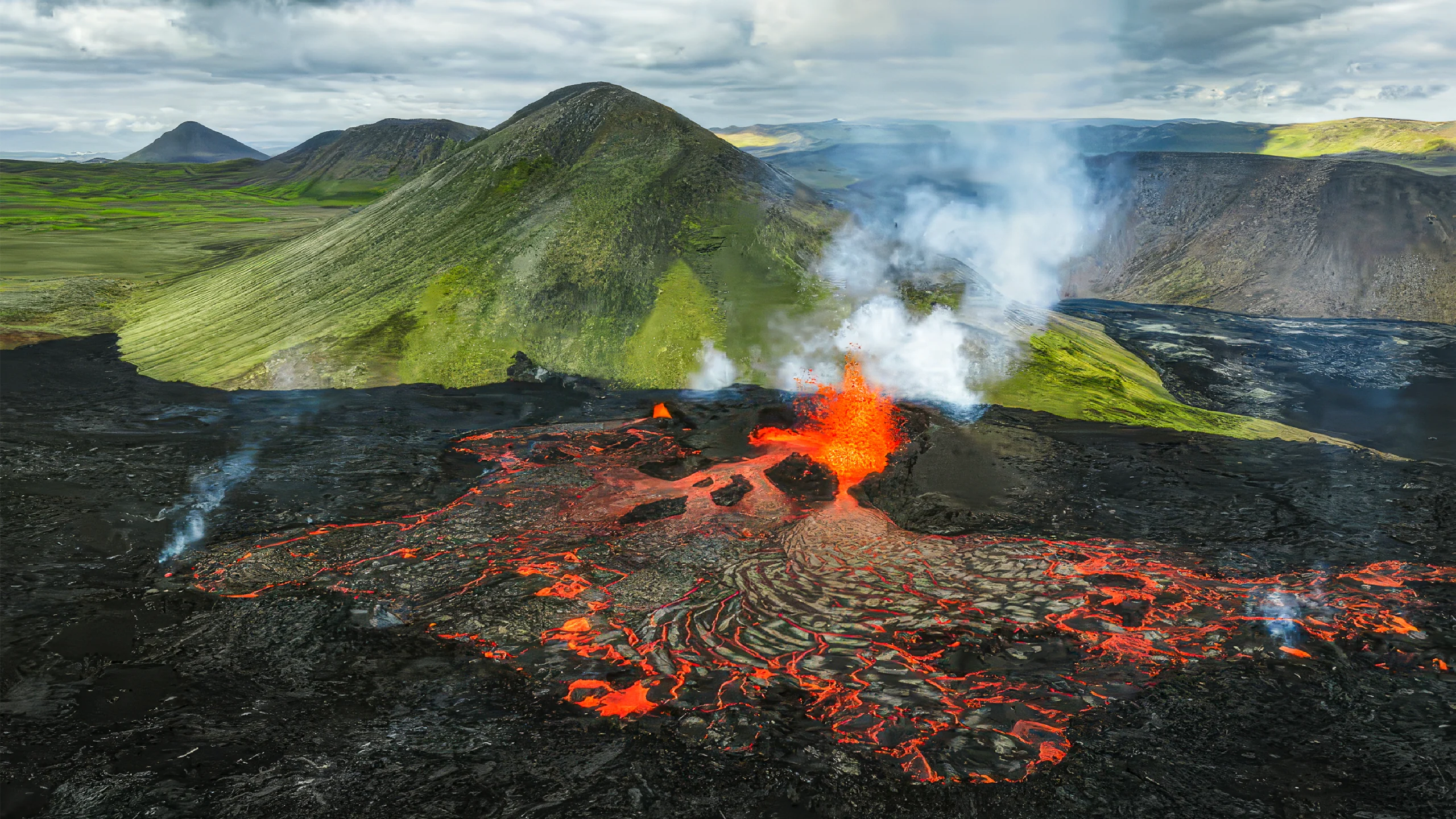
The article in Quanta Magazine (which has some wonderful photos) describes, at length, coupled volcanos. I recommend reading it. I attach a summary produced by ChatGPT.
The Quanta Magazine article “When Coupled Volcanoes Talk, These Researchers Listen” explores a growing realization in volcanology: volcanoes are not always isolated systems, but can be physically connected and interact through shared underground magma pathways. By tracking how magma moves between volcanoes, scientists are uncovering “conversations” between volcanic systems that could improve eruption forecasting and deepen understanding of Earth’s interior dynamics.
The article begins with the famous 1912 eruption in Alaska involving Mount Katmai and the Novarupta vent. For decades, scientists assumed Katmai itself erupted and collapsed after expelling its magma. However, later geological mapping revealed that the eruption actually occurred about 10 kilometres away at Novarupta, which had effectively drained magma from Katmai. This discovery provided early evidence that magma can move laterally across significant distances, linking separate volcanic structures.
Modern research has expanded on this idea, showing that such connections are not rare. Advances in monitoring technologies—such as seismometers that detect magma movement and satellite-based measurements of ground deformation—allow scientists to track magma migration in near real time. These tools reveal that magma does not always rise vertically, as once assumed, but can flow sideways through complex subterranean networks.
A key focus of current research is Iceland’s Reykjanes Peninsula, where volcanic systems appear to operate in sequence. After eruptions at one fissure system, activity can shift to another nearby system, suggesting that magma is redistributed underground. This behaviour gives the impression that volcanoes are “talking” to each other—when one system quiets down, another becomes active. Such patterns indicate that volcanic regions may function as interconnected networks rather than independent vents.
Scientists are now attempting to map these hidden magma pathways and understand the physical mechanisms behind them. Magma behaves like a complex fluid mixture, with its viscosity depending on composition—silica-rich magma is thicker, while low-silica magma flows more easily. These properties influence how magma travels through the crust and how it links different volcanic systems.
Understanding these connections has practical importance. If magma can shift from one volcano to another, monitoring a single volcano in isolation may be insufficient for predicting eruptions. Instead, researchers must consider entire volcanic regions as integrated systems. By identifying patterns of magma transfer, scientists hope to anticipate where eruptions might occur next, even if the triggering signals originate elsewhere.
Ultimately, the research highlights a shift in how volcanologists conceptualize volcanic behaviour—from isolated eruptions to dynamic, networked systems. By “listening” to how volcanoes interact through shared magma, scientists are developing a more nuanced and predictive understanding of volcanic activity. This approach could lead to better hazard assessments and earlier warnings for communities living near active volcanic regions.


No comments:
Post a Comment