Saturday, 18 July 2026

Oceanic-plate Volcanism
Oceanic-plate Volcanism

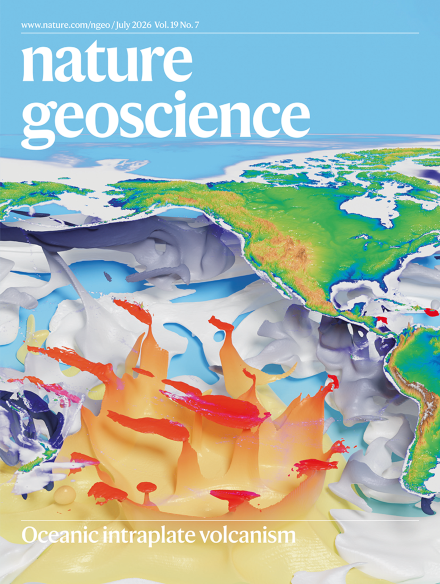
The latest edition of NATURE GEOSCIENCE has several papers on the volcanism found on oceanic plates. This includes seamounts and vast drowned plateaus. The seamounts are often found in chains, but not every sea mount is in a chain. The magazine has a rather nice cover illustration.


This issue of Nature is reviewed in Earth-logs which has a more extensive version of the Nature cover.


3-D simulation of geodynamics beneath the Pacific and Indian Ocean floors. Credit: Hao Dong, Institute of Geology and Geophysics, Chinese Academy of Sciences.

The latest edition of Geology Bites - a podcast about all things geological - also focuses on seamounts, especially those in chains. The scientist interviewed is Bernhard Steinberger. I recommend looking at the website as well as listening to the podcast.

So there is a lot of interest in this subject at the moment. And I wish I could give a simple explanation of the conclusions of all this work.

I can't, but my minion, Google Gemini can! The Nature papers can be summarised as follows:-

--------------------------------------

For decades, geologists used a simplified, step-by-step approach to map the Earth: volcanoes form over static "hot spots," plates move at ridges, and sink at subduction zones. However, recent studies published in Nature Geoscience show that the deep Earth is far more interconnected, messy, and dynamic than previously thought.

The key takeaways from the new research include:

"Seamount Breweries": Scientists used to think underwater volcanoes (seamounts) only formed in neat lines as a tectonic plate moved over a single, stationary "hot spot." However, most seamounts are scattered randomly. A new 290-million-year computer simulation explains why: massive, rising blobs of heat from deep near the Earth's core break apart as they hit the upper mantle. This creates wide, drifting "hot zones" that act like "breweries," popping up clusters of random volcanoes over time.

Deep Earth Launchpads: Volcanoes are much more common on ocean floors that have drifted over huge, super-hot structures at the very bottom of the Earth's mantle (called LLSVPs). These deep structures act like permanent engines launching heat upward.

The Connected Domino Effect: Massive volcanic plateaus, like the Ontong Java Plateau in the Pacific, didn't just form from a simple hot plume. New models suggest that about 130 million years ago, a sudden increase in plates sinking (subducting) around the edges of the Pacific Ocean forced the Earth's interior to rearrange. This slowed down sea-floor spreading at the ridges, forcing intense heat to escape elsewhere—melting dense, old crust deep down and pouring out unprecedented amounts of magma onto the deep ocean floor.

The Big Picture Change:
Geology is moving away from looking at isolated puzzle pieces. Instead, scientists now view the entire planet as a single, connected web where a change in one area (like a sinking tectonic plate) instantly triggers a massive reaction somewhere else (like a giant underwater volcanic eruption thousands of miles away).

------------------------------------------

And the Geology Bites podcast can be reduced to:-

-------------------------------------------

In this Geology Bites podcast episode, geophysicist Bernhard Steinberger discusses whether mantle hotspots (the deep plumes of hot rock that feed volcanic chains like Hawaii) are truly stationary.

His research and modeling lead to several key conclusions about mantle dynamics, plate tectonics, and how we map ancient Earth:

1. Hotspots Are Not Fixed

For decades, scientists assumed hotspots were stationary anchors that could be used as a fixed frame of reference to measure tectonic plate movement. Steinberger’s core conclusion is that hotspots actively move. They are bent and blown sideways (advected) by the massive mantle convection currents they must rise through—similar to smoke bending in a breeze.

2. The Famous "Hawaiian-Emperor Bend" Required Two Things

The striking, sharp 60-degree bend in the Hawaii-Emperor seamount chain (formed around 47 million years ago) was long thought to be caused solely by a sudden change in the Pacific plate's direction. Paleomagnetic data and Steinberger’s models show a dual reality:

  • The Hawaii hotspot itself was drifting rapidly southward (at about 3.5 cm per year) before 47 million years ago and then slowed or shifted.

  • The sharpness of the bend required both a change in plate motion and a change in the hotspot's own drift coinciding at the same time.

3. Hotspots Move Independently

Hotspots do not move together as a rigid grid. Each one drifts at its own speed and direction (typically around 1 cm per year) depending on its local mantle environment. For example, while the Hawaii hotspot was moving southward, its South Pacific neighbor, the Louisville hotspot, was drifting slowly eastward. This independent movement is the definitive proof that they are not fixed relative to each other.

4. Why Hotspots Stay Relatively Anchored

Despite this movement, hotspots change position slowly enough to still be highly useful. Whole-mantle seismic tomography reveals why: the plume conduits are incredibly thick (several hundred kilometers across) and rooted in dense, sluggish thermochemical piles (LLSVPs) right at the core-mantle boundary. Because the lower mantle moves so slowly, the roots of these plumes stay relatively stable.

5. A "Moving Hotspot Reference Frame" is Necessary

Because we cannot treat hotspots as completely stationary, geophysicists must use Steinberger's mantle-flow models to calculate past hotspot drift. By factoring in this drift alongside paleomagnetic data (which tracks a plate's latitude relative to Earth's spin axis), scientists can establish a more accurate "moving hotspot reference frame" to reconstruct how tectonic plates moved relative to the deep mantle over hundreds of millions of years.

6. The Whole Lithosphere Drifts Westward

When you sum up the total movement of all tectonic plates within this deep-mantle reference frame, the entire outer shell of the Earth (the lithosphere) exhibits a net westward rotation of about 1.5 cm per year at the equator. Steinberger concludes that this isn't caused by tidal forces from the Moon, but is simply driven by the massive Pacific plate being dragged rapidly westward by subduction zones along its edges.

------------------------------------


No comments: