Subducted Slabs - Where and How
Earth-Logs, one of this blogs favourite sources has come up with an interesting article which you can find HERE. It is based on THIS ARTICLE which will appear in a Nature Journal soon.
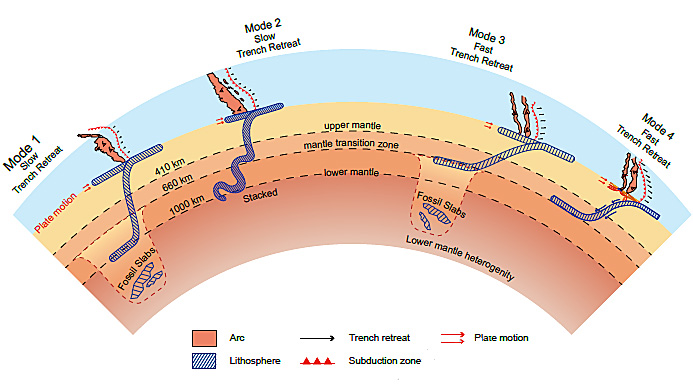
It concerns subducting plates and what happens to them. It is thought that mineral density changes are the main control, but the authors of the paper suggest that another control is viscosity changes caused by cooler slabs entering the mantle. Their paper is summarised below (by ChatGPT) and further summarised in the diagram at the bottom of this page.
This is fascinating stuff but all the evidence is gained at a distance and we will never get there. So we have to be content with speculating about phase changes and viscosity. But these are the best explanations we have for the observations we make.
Seismic tomography does not support the idea that oceanic slabs sink intact all the way to the core–mantle boundary. Instead, many slabs stall and accumulate at depths around 660 km and 1000 km. The 660 km boundary is reasonably explained by pressure-driven mineral changes (especially in olivine) that increase density and resist further sinking. However, no equivalent mineral transition explains stagnation at ~1000 km depth.
Recent research by Jing Li and colleagues proposes that variations in mantle viscosity, rather than just mineral density changes, control slab behaviour. Their combined experimental and modelling work suggests that as slabs descend, they trigger recrystallization in the surrounding mantle, reducing grain size and creating localized low-viscosity zones. These zones can either facilitate or hinder slab movement, leading to complex, uneven descent.
They identify four subduction modes depending on trench retreat speed and mantle properties:
- Slow retreat + low-viscosity patches → slabs penetrate past 660 km but stagnate at ~1000 km
- Slow retreat + uniform mantle → slabs buckle between 660–1000 km
- Fast retreat (with or without low-viscosity zones) → slabs stagnate at ~660 km
The study also suggests that older, “fossil” slabs may weaken the mantle and create low-viscosity regions that influence later subduction. These processes help explain seismic observations and imply that the mantle is highly heterogeneous.
Overall, the findings highlight that mantle dynamics are complex, with past tectonic activity influencing present-day plate motion, deep mantle convection, plume formation, and the chemical diversity of mantle-derived magmas.


No comments:
Post a Comment