Thursday, 23 March 2017

Spherical world - flat maps

Map projections

This has little to do with geology but as we are always dealing with maps it is not without interest. read all about it HERE


Dinosaurs revisited - again

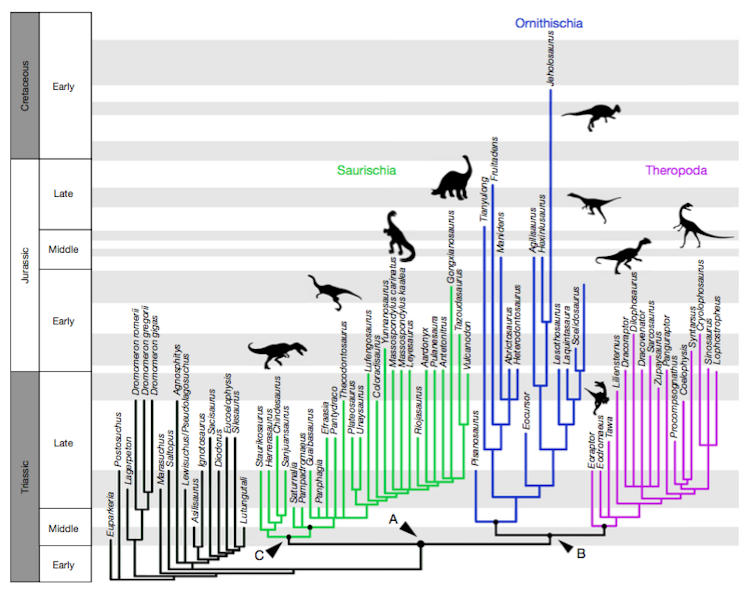
Will the Dinosaur Family Tree be Rewritten?

Mike Benton writes HERE that recent research in cladistics might necessitate a reappraisal of dinosaur evolution. I don't pretend to understand it but it is probably important!


Tuesday, 21 March 2017

Jokes

Geological Jokes

While procrastinating in front of my computer I came across THIS PAGE. I expect that the jokes may elicit a few groans - Some were old when I was a boy in the Holocene.


Geological Photos

Rather Nice Geological Photos - Mostly


I found these photos online and thought some of them were rather good. Hope you like them.

Saturday, 18 March 2017

Next week 20th to 26th March 2017


NEXT WEEKS EVENTS

20th to 26th March 2017
The following is an extract from Bristol Geology Calendar

More details can be found in the Calendar and on the web sites of the relevant Society or organisation.


Monday

Teme Valley Geol Soc - Lecture
WhenMonday, 20 Mar 2017
WhereMartley Memorial Hall B4197 by Sports Ground (map)
DescriptionThe Quaternary, Dr Eleanor Brown Contact:- Janet 01886 821061 Mem £1 Non £3


Tuesday

18:30
 Geological Society - Western Region
WhenTue, 21 March, 18:30 – 19:30
WhereS H Reynolds lecture theatre, Bristol University, Queens Rd, Bristol BS8 1RJ (map)
DescriptionReconstruction of Lake Ohrid Reconstruction of past environmental change from sediments of Europe's oldest lake, Lake Ohrid (>1.4 Ma) Provisional event Speaker Jens Holtvoeth - Bristol University

Wednesday


Thursday

19:30
 Dave Green's microscope course
WhenThu, 23 March, 19:30 – 21:30
WhereThe Chantry, Thornbury. (map)
DescriptionRocks and Minerals under the Microscope.  This 10 week course aims to introduce you to the identification and description of rocks and their component minerals under the petrological microscope. This is a practical course, each participant will be provided with a microscope and a set of thin sections of rocks, and will work through a course at their own pace. Held at The Chantry, Thornbury. First meeting 7.30 – 9.30, Thurs 12th January until March 23rd (not Thurs 16th Feb) in the Buckingham Room. Max. numbers 20, “first come, first served” due to number of slide sets. Cost £75


Friday


Saturday


Sunday


Friday, 17 March 2017

Rhynie Chert explained

Rhynie Chert 100 years old (+410Ma)!

The first publication on the Rhynie Chert was published 100 years ago.

(Kidston, R. & Lang, W. H. 1917. On Old Red Sandstone plants showing structure, from the Rhynie chert bed, Aberdeenshire. Part I. Rhynia gwynne-vaughani Kidston & Lang. Transactions of the Royal Society of Edinburgh51(24): 761- 784.) 

Although there were mentions in 1913:-

(Mackie, W. 1913. The Rock series of Craigbeg and Ord Hill, Rhynie, Aberdeenshire. Transactions of the Edinburgh Geological Society10: 205-236.) 

(Newlands, M. A. 1913. Note on a fossil plant from the Old Red Sandstone, Rhynie, Aberdeenshire. Transactions of the Edinburgh Geological Society, 10 (Session 78, 1911-12): 237.)

Earlier this year the Royal Society held a meeting to share the present knowledge and there is a very good report in the Guardian about this. The comments after the report are interesting; some are entertaining.

The Rhynie chert is renowned for the exquisite preservation of the plants and animals within it. This despite its great age - Pragian, Early Devonian, formed about 410 million years ago. The preservation is thought to be due to it being close to silica rich hot springs similar to present day Yellowstone. 
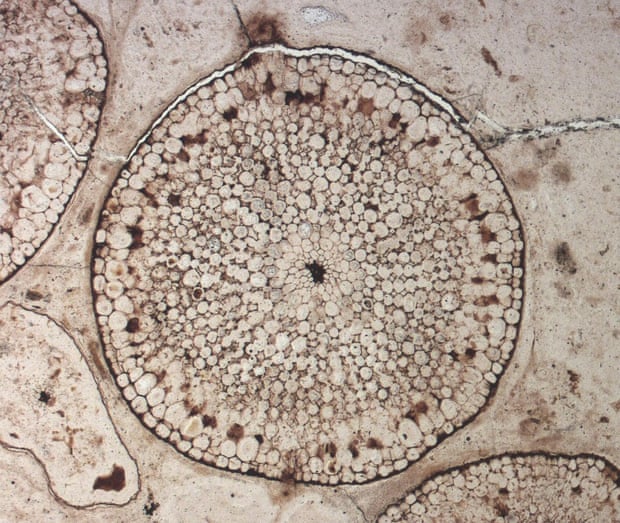
 Transverse section of a stem of Rhynia. Photograph: Paul Kenrick


Tuesday, 14 March 2017

New minerals in the FT

More About New Minerals


The Financial Times is the latest to comment on the emergence of new minerals due to the efforts of humans. Read it HERE.

My favourite is Tinnunculite, found in Russia and formed as hot gases from a burning coal mine dump react with the droppings of the Eurasian kestrel. So biology, economic geology, environmental degradation and chemistry combine - amazing!

Tinnunculite is described HERE as:

Tinnunculite [C5H4N4O3·2H2O]

This mineral was discovered by  Igor V. Pekov, Inna S. Lykova, Vasiliy O. Yapaskurt, Natalia V. Zubkova (Lomonosov Moscow State University, Russia), Nikita V. Chukanov (Institute of Problems of Chemical Physics, Moscow, Russia), Dmitry I. Belakovskiy (Russian Academy of Sciences, Moscow, Russia), Elena P. Shcherbakova (Institute of Mineralogy, Russian Academy of Sciences, Miass, Russia), and Sergey N. Britvin (Institute of Earth Sciences, St. Petersburg State University, Russia) on Mt Rasvumchorr, Kola peninsula, Russia. This mineral was not specifically predicted in the Hazen et al (2015) paper, but was found near Kukisvumchorr Mountain, a location predicted to harbor undiscovered carbon minerals. Mineralogists have described 91 minerals on Mt Rasvumchorr, but only 6 of the known minerals contain carbon. This mineral is an example of a rare mineral species that only exists under very specific conditions. In this case, tinnunculite forms when hot gases from a burning coal dump react with excrement from the European Falcon (Falco tinnunculus).  This makes tinnunculite a very rare and fragile mineral species. The mineral was named in honor of the species of falcon whose excrement is needed to crystallize it [3].


Common kestrel (Falco tinnunculus). Credit Andreas Trept