Saturday, 9 June 2018

Organic material on Mars

Organic Material Found on Mars - Was it Alive?

Monica Grady of the Open University writes HERE of the discovery of small quantities of kerogen like material on Mars. It is not yet known if this is of biological origin. She hopes that future missions will resolve the question.

She also discusses the presence of surprisingly large quantities of methane in the Martian atmosphere.

Mars seems to be producing lots of questions. Finding the answers should be interesting - and provide many more questions.

Ediacaran footprints

Footprints of Ediacaran Age

It is reported Here (in The Guardian) and HERE (the original article) that footprints of some unknown animal have been found in the Yangtze Gorges of China. They are between 541 and 551 million years old and are the earliest known trackways.

The animation has been produced by the Guardian so is not authoritative. It is more interesting if less informative than the photos in the original!


Wednesday, 6 June 2018

The Bristol Avon and its Hot Springs

The Bristol Avon and its Hot Springs: a river's course peculiar

Nick Chidlaw has asked me to publicise this new course. It looks very interesting.

July – field course studying the landforms and underlying geology of the river Avon valley between Trowbridge and Clifton, Bristol
 
2 day course:
 

The Bristol Avon and its Hot Springs: a river’s course peculiar
 

A weekend late July: 21st and 22nd
 
10.00 am – 5.00 pm each day. 
 
Tuition fee is  £45.00 per person
 
Deadline for course viability: 23rd June
 
Enrolments can be made and further details requested by contacting tutor Nick Chidlaw nickchidlaw@gmail.com 

A field weekend examining the course of the river between Trowbridge, Wiltshire and the gorge at Clifton, Bristol. In this tract, the Avon repeatedly enters upland via a gorge, instead of crossing adjacent lower ground. Along its course at Bath and Hotwells, Bristol, occur hot springs. The course focuses on these curious / unusual features, and considers possible causes. One published proposal in fairly recent years, that the course and its hot springs may have been a product of active fault movement during the Ice Age, has since been refuted by the absence of geophysical evidence. 

For the course, a handout outlining the two-day programme, including location sketch maps, optional reading list, and outline geological history, will be forwarded in advance of the course to those enrolled.

Saturday, 2 June 2018

4th to 10th June 2018

NEXT WEEKS EVENTS
4th to 10th June 2018
THE FOLLOWING IS AN EXTRACT FROM BRISTOL AND WEST COUNTRY GEOLOGY CALENDARS

MORE DETAILS CAN BE FOUND IN THE BRISTOL AND THE WEST COUNTRY CALENDARS AND ON THE WEB SITES OF THE RELEVANT SOCIETY OR ORGANISATION.

MONDAY 4th

Dave Green - Planetary Geology
When
Mon, 4 June, 19:30 – 21:30
Description
Planetary Geology. Monday 16th April, for 10 weeks, until 9th July (not 7th nor 28th May). The state of knowledge of the planets of the solar system has improved vastly in the past 40 years as a result of space missions and improved technology for observation and analysis. The course will examine the results of this activity and evidence for these interpretations in terms of the internal structure, magnetism and geophysics of these bodies; their tectonics and volcanism, the effects of impacting bodies, and the surface conditions –atmospheres, oceans, sedimentary features and biology. Held at Wynstones School, Stroud Road, Whaddon, Gloucester from 7.30-9.30pm on Mondays. Cost £70.

Dave Green, Joys Green Farm, Forge Hill, Lydbrook, Glos GL17 9QU Tel 01594 860858

davegeostudies@gmail.com

TUESDAY 5TH

Dave green, Field Course - Geology and Landscape in Gloucestershire
When
Tue, 5 June, 19:00 – 21:00
Where
Meet at the car park for the picnic site at Coaley Peak GR SO 794014 (map)
Description
Geology and Landscape in Gloucestershire (evening field course Tuesdays 7-9 First meeting point:- Frocester Hill: Meet at the car park for the picnic site at Coaley Peak GR SO 794014 . Further sessions on website, separate leaflet, and/or by contacting Dave Green.

Dave Green, Joys Green Farm, Forge Hill, Lydbrook, Glos GL17 9QU Tel 01594 860858

davegeostudies@gmail.com

WEDNESDAY 6TH


THURSDAY 7th

Bath Geol Soc - Lecture
When
Thu, 7 June, 19:30 – 21:00
Where
Bath Royal Literary and Scientific Institution, 16 Queen Square, Bath (map)
Description
Subduction zone earthquakes and tsunami – exploring the Sumatra subduction zone (the source of the 2004 Indian Ocean tsunami) using marine geology and geophysics and ocean drilling

Lisa McNeill - Ocean and Earth Science, National Oceanography Centre Southampton, University of Southampton

The 2004 magnitude 9.1 earthquake and resulting tsunami originated on the subduction zone margin offshore North Sumatra (part of the Sunda subduction zone system). The resulting tsunami killed more than 200,000 people, devastating large coastal regions around the Indian Ocean, in particular in North Sumatra (Aceh) and Thailand.

Since the earthquake, a large number of countries, in collaboration with Indonesia, have invested in collection of geological and geophysical data in order to better understand the structure of this subduction zone and its potential for large earthquakes and tsunami. The data are also important for a general understanding of these processes and of other subduction zones worldwide. The UK has played a significant role in this effort. This talk will show some of the results of data collected in projects over the last few years, including those led by UK scientists. This includes marine geophysical data that images below the seafloor to show the structure of the subduction zone and the properties of the faults that move and generate the earthquakes. Sediment cores sampling the upper few metres below the seafloor have also been collected to see where submarine sediment flows were triggered by the earthquake shaking in 2004 and in previous earthquakes.

Finally, in 2016, an expedition of the international Integrated Ocean Discovery Program (IODP: scientific ocean drilling) drilled the sediments coming into the subduction zone. These sediments, which originate from the Himalaya and Tibetan Plateau, form the tectonic plate boundary fault – their properties ultimately control the behaviour of the fault. Drilling and sampling of these sediments has now provided information about the properties of the fault zone and why it generated such a large earthquake and tsunami.


FRIDAY 8th

Cheltenham Mineral and Geological Society - Lecture
When
Fri, 8 June, 19:00 – 21:00
Where
Shurdington at The Century Hall (map)
Description
   'Subject to be confirmed '
    Our guest speaker is          Dr Alice Kennedy.Gloucestershire Geology Trust.

SATURDAY 9th


SUNDAY 10th


The earliest reptile

Reptiles Existed Before the Great Dying

In yet another article from The Guardian the earliest reptile yet found is described. 

Megachirella wachtleri, has been unveiled as the oldest known member of a group of reptiles known as squamates – which includes lizards, snakes and peculiar legless creatures known as worm lizards. But more - using various means which I do not pretend to understand (see this) - although the beastie is dated as 240 million years old it is concluded that its species existed before the Permian/Triassic extinction event (252 million years ago).

The fossil which led to all this work was found in the Dolomites and may have looked like this:-


An artists’ impression of Megachirella wachtleri walking through the vegetation in the Dolomites 240m years ago. Photograph: Davide Bonadonna/Nature


Dinosaur dandruff

History of Dandruff - Part I

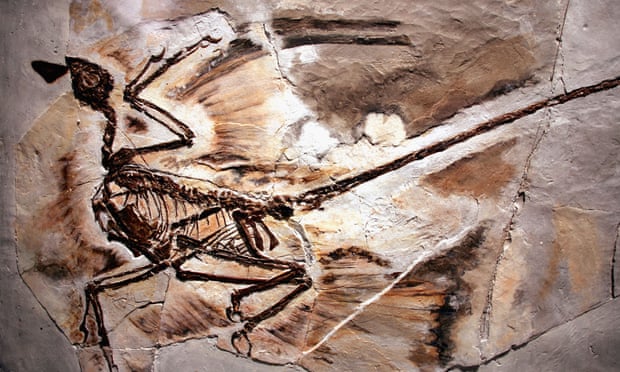
This article in the Guardian describes the identification of dandruff in a small, feathered, 125 million year old, dinosaur. 

Flakes of fossilised skin were found on the remains of beipiaosaurus and sinornithosaurus, which are dinosaurs, and also the early bird confuciusornis.

The discovery is of interest as it gives an indication of how dinosaurs shed their skins - in tiny flakes, rather than large sheets as modern reptiles do.

A Part II of this history is not anticipated.

 A fossil of a microraptor found in Liaoning province, China. The crow-sized dinosaur lived about 125m years ago. Photograph: Spencer Platt/Getty Images

Saturday, 26 May 2018

28th May to 3rd June 2018

NEXT WEEKS EVENTS
28th May to 3rd June 2018
THE FOLLOWING IS AN EXTRACT FROM BRISTOL AND WEST COUNTRY GEOLOGY CALENDARS

MORE DETAILS CAN BE FOUND IN THE BRISTOL AND THE WEST COUNTRY CALENDARS AND ON THE WEB SITES OF THE RELEVANT SOCIETY OR ORGANISATION.

MONDAY 28th


Tuesday 29th


Wednesday 30th


Thursday 31st


Friday 1st


Saturday 2nd


Sunday 3rd