Saturday, 9 March 2019

11th to 17th March 2019


NEXT WEEKS EVENTS

11th to 17th March 2019

THE FOLLOWING IS AN EXTRACT FROM BRISTOL AND WEST COUNTRY GEOLOGY CALENDARS

MORE DETAILS CAN BE FOUND IN THE BRISTOL AND THE WEST COUNTRY CALENDARS AND ON THE WEB SITES OF THE RELEVANT SOCIETY OR ORGANISATION.


MONDAY 11TH

Course - The Geology of Eruptions, Earthquakes and Tsunamis
When
Mon, 11 March, 19:30 – 21:30
Where
Wynstones School, Stroud Road, Whaddon, Gloucester (map)
Description
The Geology of Eruptions, Earthquakes and Tsunamis  
Three of the most devastating natural disaster-forming events are geological, all related to plate tectonics, and are very difficult, if not impossible, to accurately forecast.  What are the causes of these events and their various manifestations? Why are some more dangerous than others? How can we prevent or mitigate these effects? Examples of some of these phenomena will be used to illustrate these points Monday 7th for 10 weeks (not 18h Feb) until 18th March. Held at Wynstones School, Stroud Road, Whaddon, Gloucester from 7.30-9.30pm on Mondays . Cost £75

Contact Dave Green by email at davegeostudies@gmail.com, by phone at 01594 960858 and by post at Dave Green, Joys Green Farm, Lydbrook, Gloucestershire, GL17 9QU

Tuesday 12th

Cardiff University Lecture - When Sea levels Change...
When
Tue, 12 March, 18:30 – 20:00
Where
The 2018-2019 monthly Tuesday evening lectures in the School of Earth and Ocean Sciences will be held in the Wallace Lecture Theatre (0.13), Main Building, Cardiff University, Park Place, CF10 3AT. Lectures begin at 18.30. Booking is not needed. (map)
Description
Neanderthal landscapes of the Channel River Valley—title tbc
Rebecca Scott (British Museum)
-----------------------------------

WEGA Lecture - Brian Williams, Snowball Earth
When
Tue, 12 March, 19:30 – 21:00
Description
Professor Brian Williams (Cork University)
Snowball Earth

Wednesday 13th

DGAG Lecture - The Cretaceous–Paleogene unconformity in England
When
Wed, 13 March, 19:00 – 21:00
Where
Dorset County Hall, Colliton Park, Dorchester, Dorset, DT1 1XJ, United Kingdom (map)
Description
Uplift and erosion related to the Icelandic mantle plume. 
Talk by Professor Andy Gale. 
This is the third of a series of Earth Science-based lectures organised by DGAG in collaboration with other groups. 
As the Dorset County Museum is closed for refurbishment, ’til summer 2020,  the lectures will take place in Committee Room 1 at County Hall. They will follow the familiar pattern of being on the second Wednesday of the month starting at 7 pm. 
Parking is available behind County Hall and is free in the evening. 

thursday 14th

Course - Advances in Understanding Earth’s Structure and Operation
When
Thu, 14 March, 19:30 – 21:30
Where
The Chantry, Thornbury. (map)
Description
Advances in Understanding Earth’s Structure and Operation. 
This 10 week course aims to introduce you to relatively new ideas, some accepted, some controversial, about the internal structure and tectonics of the Earth. Many ideas have changed radically since the inception of the Plate Tectonic hypothesis, and especially in the period from the 1990s, partly as a result of new technology, and the re-examination of parts of the theory that evidence did not support. Each week we will examine a different topic, such as subduction, mantle dynamics, mantle plumes.   Held at The Chantry, Thornbury.  First meeting 7.30 – 9.30, Thurs 10th January until March 21st (not Thurs 21st Feb). Cost £75

Contact Dave by email at davegeostudies@gmail.com, by phone at 01594 960858 and by post at Dave Green, Joys Green Farm, Lydbrook, Gloucestershire, GL17 9QU

friday 15th


saturday 16th

Visit to see the fossil collections of Wolfgang Grulke & Dr John Whicher.
When
Sat, 16 March, 10:00 – 16:00
Where
Dorset (map)
Description
Further details from the Chairman - Phil james

sunday 17th


Down to Earth Extra - March 2019

Down to Earth Extra - March 2019

You can get the latest edition HERE. Sorry I am a little late with this but I have been away.


Sunday, 3 March 2019

Florping and blorping

Counting Small Objects in the Kuiper Belt, and What it Means

Pluto is in the Kuiper Belt and is the largest object in the belt. We know of a few thousand more ranging in size down to several tens of kilometres in size. But smaller objects are too faint to see with telescopes.

So, how to estimate how many small objects are there in the Kuiper Belt?

THIS PAPER describes an ingenious way of doing this. Count and measure the size of craters on Pluto and its moon, Charon.

Flyby images allow craters as small as 1.4km to be mapped. Those must have been made by impacts of Kuiper Belt objects not much bigger than 100 metres in size.

Crater sizes down to 13km (produced by objects about 1 to 2km in size) have a distribution which matches expectations. But smaller craters are much less abundant than expected. So a dearth of smaller Kuiper Belt objects.

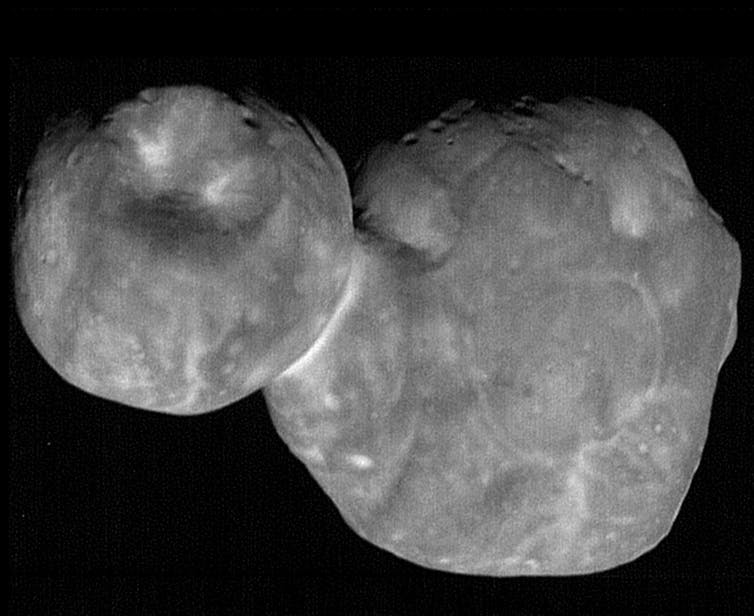
Kuiper belt object 2014 MU₆₉. The two-lobed object is about 30km from end to end. NASA/Johns Hopkins Applied Physics Laboratory/Southwest Research Institute, National Optical Astronomy Observatory

The object photographed is better known as Ultima Thule. And close examination of the photo suggest a reason for the lack of smaller objects in the Kuiper Belt.

Each of the lobes seems to be formed of component parts that merged vigorously enough to squish together into an approximate sphere, but with insufficient violence to smash each other apart. This has been called "BLORPING". "FLOMPING" describes the coming together when two lobes meet without causing any deformation.

Because the Kuiper Belt is so far from the sun, orbital speeds are slower, and therefore collisions would be less violent. Instead of falling apart the small objects would tend to amalgamate - and thus the lack of smaller impact craters on Pluto is explained.

There is more in this article than I have written about - it is well worth reading!


Charnwood with Nick Chidlaw

Precambrian Geology at Charnwood Forest, Leicestershire.

Nick Chidlaw has asked me to publicise this course. We are very happy to oblige!

Charnwood Old Cliffe Hill Quarry - buried landscape

Lifelong Learning 4 day course

Precambrian Geology at Charnwood Forest, Leicestershire 

Tutor: Dr Nick Chidlaw
Saturday 22nd – Tuesday 25th June 2019
10.00 am – 5.00 pm each day
In the eastern English Midlands, the generally subdued relief is conspicuously interrupted by the craggy, locally—wooded hills of Charnwood Forest, a few miles north-west of Leicester. Here are found rocks formed from explosive volcanic eruptions about 600 million years ago, together with lavas and igneous intrusions. Within rocks that were once volcanic ashes have been found world-famous fossil sea pens and jellyfish, predating the earliest known shelly fossils.
Attached photograph is of Old Cliffe Hill Quarry, where the South Charnwood Diorites are worked for aggregate. Here, the Diorites are intruded into the Bradgate Formation, both formed in the Ediacaran Period. A late Triassic desert land surface is preserved in profile, overlain by the Mercia Mudstone Group. 
No prior knowledge of geology or the area is assumed. Attendees arrange their own travel, meals and accommodation – tutor can advise.
Meeting location provided to those enrolled. The course is organised through Cardiff University. It carries assessment, which is very difficult to fail! Attendees usually find assessment on these courses useful for consolidating what they have learned.
Tuition fee is £165.00 (concessionary fee available £ 132.00)

Enrolments can be found by ‘phoning 029 2087 0000 or visiting website www.cardiff.ac.uk/learn

For more information on the course, contact tutor nickchidlaw@gmail.com

Saturday, 2 March 2019

4th to 10th March 2019


NEXT WEEKS EVENTS

4th to 10th March 2019

THE FOLLOWING IS AN EXTRACT FROM BRISTOL AND WEST COUNTRY GEOLOGY CALENDARS

MORE DETAILS CAN BE FOUND IN THE BRISTOL AND THE WEST COUNTRY CALENDARS AND ON THE WEB SITES OF THE RELEVANT SOCIETY OR ORGANISATION.


MONDAY 4TH

Course - The Geology of Eruptions, Earthquakes and Tsunamis
When
Mon, 4 March, 19:30 – 21:30
Where
Wynstones School, Stroud Road, Whaddon, Gloucester (map)
Description
The Geology of Eruptions, Earthquakes and Tsunamis  
Three of the most devastating natural disaster-forming events are geological, all related to plate tectonics, and are very difficult, if not impossible, to accurately forecast.  What are the causes of these events and their various manifestations? Why are some more dangerous than others? How can we prevent or mitigate these effects? Examples of some of these phenomena will be used to illustrate these points Monday 7th for 10 weeks (not 18h Feb) until 18th March. Held at Wynstones School, Stroud Road, Whaddon, Gloucester from 7.30-9.30pm on Mondays . Cost £75

Contact Dave Green by email at davegeostudies@gmail.com, by phone at 01594 960858 and by post at Dave Green, Joys Green Farm, Lydbrook, Gloucestershire, GL17 9QU

Tuesday 5th


wednesday 6th


Thursday 7th

Bath Geol Soc - Lecture
When
Thu, 7 March, 19:30 – 21:00
Where
Bath Royal Literary and Scientific Institution, 16 Queen Square, Bath (map)
Description
Dr. Tiago Alves (Cardiff )

'Oil and Gas fields of the 22nd Century'
 
Abstract:
 
'Hydrocarbon exploration and production are experiencing crucial changes at the moment, as environmental aspects are becoming more important as the world's population continues to grow. The planet will host some 9 billion people at the end of the 21th century, with most of the population growth occurring in developing countries. Hence, the way oil and gas is used, at present, will change dramatically in this Century so that we can curtail CO2 emissions (and atmospheric pollution) while tackling energy poverty. This talk will present some interesting geological facts from the largest oil and gas fields in the world. It will show how these fields are being exploited in an ever more sustainable way. The examples provided will illustrate how governments, industry and the public are investing in new technologies and approaches to energy production.'
--------------------------------------

Course - Advances in Understanding Earth’s Structure and Operation
When
Thu, 7 March, 19:30 – 21:30
Where
The Chantry, Thornbury. (map)
Description
Advances in Understanding Earth’s Structure and Operation. 
This 10 week course aims to introduce you to relatively new ideas, some accepted, some controversial, about the internal structure and tectonics of the Earth. Many ideas have changed radically since the inception of the Plate Tectonic hypothesis, and especially in the period from the 1990s, partly as a result of new technology, and the re-examination of parts of the theory that evidence did not support. Each week we will examine a different topic, such as subduction, mantle dynamics, mantle plumes.   Held at The Chantry, Thornbury.  First meeting 7.30 – 9.30, Thurs 10th January until March 21st (not Thurs 21st Feb). Cost £75

Contact Dave by email at davegeostudies@gmail.com, by phone at 01594 960858 and by post at Dave Green, Joys Green Farm, Lydbrook, Gloucestershire, GL17 9QU

Friday 8th

Cheltenham Mineral and Geological Society - AGM and Annual Competition
When
Friday, 8 Mar 2019
Where
Shurdington at The Century Hall (map)

Saturday 9th

OUGS Wessex - Field Trip 
When
Saturday, 9 Mar 2019
Where
National Oceanography Centre, Southampton (map)
Description

Palynology


Leader: Prof. John Marshall

Location: National Oceanography Centre, Southampton

Date: 9th March 2019

Type: Field Trip (Day)

Summary: A day in the laboratory, looking at fossil pollen and spores to study past environments.

More info:

More details to follow. Date not yet confirmed.

Contact: Jeremy Cranmer   [wessexdaytrips@ougs.org]
--------------------------------------

Bristol Nats - Field Meeting
When
Sat, 9 March, 14:00 – 16:00
Where
Meet in the car park off Cleeve Hill Road by the Goblin Combe Environment Centre. Grid ref: ST458 654. (map)
Description
GEOLOGY SECTION WALK UP GOBLIN COMBE, CLEEVE


2.00 p.m. Saturday 9 March 2019

This is an informal walk up Goblin Combe with the intention of finding and examining the Carboniferous age volcanic rocks. Meet in the car park off Cleeve Hill Road by the Goblin Combe Environment Centre. Grid ref: ST458 654. Buses from Bristol X1 and X2 run every quarter of an hour from Bristol Bus Station. Alight at the stop by the now sadly boarded up Lord Nelson PH and walk back a short distance in the direction of Bristol and then turn right into Cleeve Hill Road by the Cleeve Village Hall. The meeting point is 200 m on your left. There will be about 4 miles of reasonably easy walking but it can be muddy in places and walking boots are necessary. If time lows it may be possible to visit the AWT reserve


Sunday 10th


Friday, 1 March 2019

Unpaid Internship Available

Unpaid Internship Available


I have received the following from the Somerset Geology Group:-

I am writing to you on behalf of the Somerset Geology Group (SGG). Working in partnership with the Somerset Environmental Records Centre, Somerset Wildlife Trust, since 2017 we have been working on  a review of Somerset's Local Geology Sites (formerly RIGS). We are seeking applications from undergraduate and post-graduate geology students to continue the project by conducting site research and surveys.


I have attached an advert for the geology interns and a Role Description. I would be grateful if you could circulate the advert and the Role Description around the students in your department to make them aware of this opportunity for valuable and interesting work experience.

I would also be interested to hear, if you know of any geological websites or blogs,  where it  would be useful for us to advertise this opportunity.

Here is the advert:-


You can download the Advert and Role Description HERE and HERE.


Blobs!

The Unsolved Mystery of the Earth Blobs

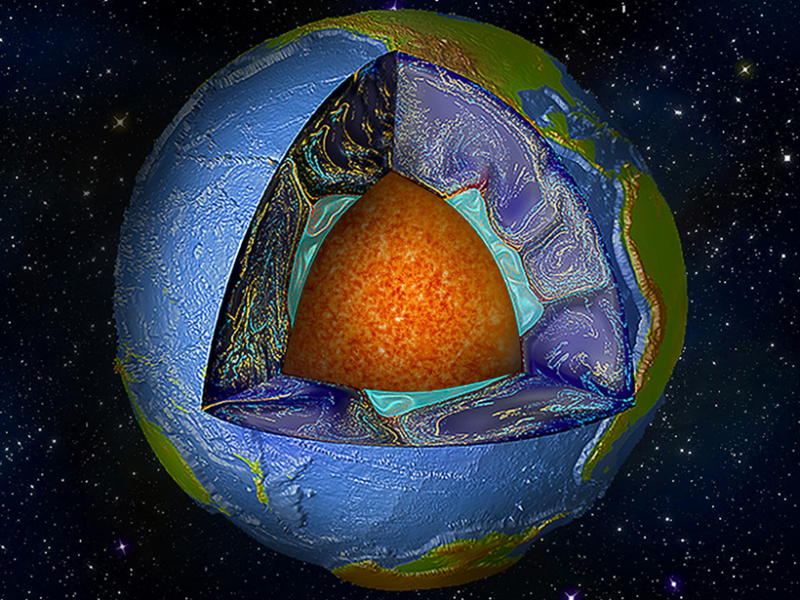
THIS LONG ARTICLE discusses two continent-sized structure found at the mantle - core boundary. These blobs, officially LLSVP or Large Low Shear Velocity Provinces, have been known since the 1970s, but although we know more about them now, we still don't know what they are, where they came from, how long they have been around, or what they do.

What lies below? A cutaway of Earth down to the liquid core shows the swirling mantle rock (dark blue). Made from a numerical convection model, the image shows mysterious structures underneath the Pacific Ocean that some researchers believe hold the clue to unlocking mysteries of Earth’s past (light blue). Credit: Mingming Li/Arizona State University


There is a lot of detail in the article and it is well worth reading.