Down to Earth Extra July 2023
The July 2023 edition of Down to Earth Extra has been published. You can download it HERE or you can read it below.


Geology and Landscape
of Gloucestershire and surroundings
A weekly field-based introductory course.
No previous knowledge of geology is assumed
Tuesday
evenings
6th
June to 11th July 2023
Gloucestershire
is one of the most geologically diverse counties in Britain.
The aim of this field-based course is to take you
towards an
understanding of local scenery. We will look at the components
- the highly diverse
rocks and their structure; and processes
- weathering, slope forming and erosion - which have
combined to
produce this equally varied landscape - the
materials from
which the scenery has been sculpted and the
processes that have acted
upon them since the area emerged from the sea 65
million years ago
(about the same time that the dinosaurs became
extinct)
No special equipment is necessary, apart from stout
footwear and
possibly waterproofs - although we will hopefully
have six balmy
summer evenings! Meetings are held on Tuesdays each
week,
meeting at 7.00 pm and finishing at 9.00 pm or later
(whenever the party feels in need of refreshment !!) at the
following meeting points (see below)
Cost: £50 for
6 week course
or £10 per
session
For further details see over or telephone
Dave Green on 01594 860858
Email Davegeostudies@gmail.com
Geology and Landscape 2023
6th June Tresham
South of Wotton under Edge,
this small village lies at the head of one of the valleys cut into the Cotswold
escarpment, on limestones lying above the Fullers Earth Clay; infamous for its
tendency to produce landslides and mudflows. The limestones include the Tresham
Rock, Athelston Oolite and the biggest area; Forest Marble, which caps the
escarpment at this point, above Hens Cliff.The steep-sided, deeply incised
valleys cutting into the scarp contrast
with the gentle sided dry valleys cut into the Cotswold dip slope during the
Ice age. We will examine the form of these valleys as well as a superb section
from the Fullers Earth down, and the contrast between the scarp and dip slopes.
Meet at the minor roadside, east of the church
(ST 794912), parking tidily (at 90o to road, if
possible should there be a lot of cars) on the verge where there is hard
standing.
13th June Plump
Hill
Known for spectacular views
across the Severn Vale, Plump Hill lies on the steeply inclined eastern limb of
the Forest of Dean coalfield. Because of the steepness of the dip of the rocks
(Old Red Sandstone and Carboniferous), all the Forest rocks are exposed within
a short distance of one another. The steep slope out of Mitcheldean on the
A4136 is due to the resistance of the rock forming the outer rampart of the
Forest – the Quartz Conglomerate, outcrops and huge detached blocks of which
can be seen on the way up. Many of the varied rocks are exposed here, thanks to
extensive exploitation in the past for various purposes. We aim to examine the
rocks, the past activity and the views, by means of a circular walk, avoiding
the road as far as possible.
Meet at the car park off the
north side of the A4136 beyond the last cottages [coming from Mitcheldean](SO 659
170).
20th June Selsley Common and Bown Hill
The Cotswold escarpment, capped by the Inferior Oolite
limestone is well displayed here, in its normally wooded cloak and as bare
common. Above the common and the deep Woodchester Park valley lies the Fullers
Earth outlier of Bown Hill, illustrating well the stepped, layered nature of
much of the scarp scenery. There are
fantastic views across the Severn Vale, across the Frome valley to Stonehouse
and Doverow Hill and across the Nailsworth and woodchester valleys. We will
take a short circular walk to illustrate the relationship between the various
rock types and the landscape they produce.
Meet at the small car park by
a dew pond at the southern end of Selsley Common, near the cattle grid. (SO 825
024)
27th
June Newent Coalfield, Oxenhall
We will examine the remnants of part of
the tiny Newent coalfield, once incorrectly heralded by Roderick Murchison as
having enormous potential wealth extending beneath the Severn Vale, and also
the effects on scenery of the local version of the Malvern Fault and the
Triassic rocks in the area to the north of Newent – the home of Dick
Whittington! Two or three sites will be visited, by car. Walking will be
minimal, car sharing is to be encouraged, with narrow lanes and limited
parking.
Meet at a
very small (park tidily at 90o to road!) lay-by/field entrance with old sleepers
as a fence on the minor road from Oxenhall to Gorsley , 100 metres SW of White House SO696268
4th July Wickwar
Wickwar is built on the
horseshoe-shaped ridge of Carboniferous Limestone that fringes the North
Bristol (Coalpit Heath) coal basin, a syncline formed by the Variscan
continental collision 300Ma ago at the end of the Carboniferous. Apart from a
different climate (hot desert), and absence of the Cotswolds, the landscape would
have looked remarkably similar 200 million years ago at the close of the
Triassic period. Limestones form the most resistant rocks, standing above the
weaker Coal Measures to the west and Old Red Sandstone with older rocks to the
east. The whole landscape was subsequently buried beneath at least a kilometre
of Mesozoic rocks, which are now being stripped off by modern erosion – a
process known as “exhumation” of the ancient landscape. We will attempt to
illustrate the rocks and scenery by means of a circular walk of approximately
4.3km.
Meet in the car park of the
Fox and Maple (formerly the Buthay), Wickwar (ST 725 886)
11th July West
Malvern to Stiffords Bridge
The Malverns represent a
window into what lies deep below the rest of England and Wales – its
Pre-Cambrian basement, which is normally hidden beneath great thicknesses of
younger rocks. These ancient igneous and metamorphic rocks were brought up from
the depths during the violent collision of continents that produced the
Variscan mountains 300 million years ago. They were pushed westward and upwards
during the collision, rucking the overlying Cambrian, Silurian and Devonian
rocks to the west up into a series of folds, repeating their outcrops and
therefore the ridges and valleys produced by modern erosion. We will aim to
illustrate these features by a linear walk of approximately 4.5km
Meet at the car park of the
Red Lion, Stiffords Bridge on A4103
(Worcester-Hereford road) (SO 766 382)
------------------------------------------------
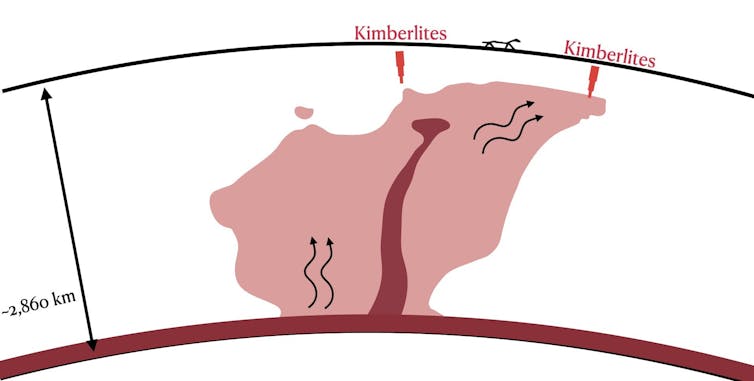
The diagram below makes it easier to understand but, no doubt, misses many of the complexities.