Saturday, 10 February 2024

Pterosaur from Skye

 Pterosaur from Skye

There has been a lot lately in the media about a pterosaur from Skye. It is based on research, much of which was done at Bristol University. The main academic paper can be seen HERE, the Bristol researcher writes about it HERE and the BBC writes about it HERE.

The fossil in question was found in 2006 at the location shown on the map below.


The fossil took much preparation and was examined in Bristol University's CT scanner. The bones are thin and fragile and the rock matrix hard so getting to the stage of examining the bones took a long time. Read the academic paper to get a flavour of all the work involved.

The main interest of the fossil is that it is more than an isolated bone and that it comes from a geologic period where a lot was happening to pterosaurs but which is poorly represented in the geologic column.

Be amazed at all the measurements the researchers have made. They have decided that it is a new species - Ceoptera evansae.


 Life reconstruction of Ceoptera evansae. Image copyright Mark Witton.

Thursday, 1 February 2024

Looking at Early Life

 Looking at Early Life


A sample of chert rock containing what may be the remains of microorganisms that lived 3.4 billion years ago. Dr. Manuel Reinhardt

Around 3.4 billion years ago, Earth hosted diverse communities of life, as evidenced by exceptionally preserved remains revealing a microorganism ecosystem with various sustenance methods. The complexity of this ancient ecosystem suggests that life had likely existed for hundreds of millions of years, starting early in Earth's history.

THIS ACADEMIC PAPER, focused on rocks from the Buck Reef Chert in South Africa, dating back 3.42 billion years. These rocks are believed to be remnants of the shallow seas around a chain of volcanic islands. The layers of rock contain microscopic carbon-based matter, likely the remains of microorganisms from the ancient seas.

Analyzing the chemical makeup of these remains, the researchers honed in on carbon isotopes, specifically carbon-12 and carbon-13. Living organisms prefer carbon-12, and the ratio between the two isotopes provides insights into an organism's metabolism. The material showed a carbon signature consistent with photosynthesis, indicating the presence of vast quantities of photosynthetic microbes near the sea surface billions of years ago.

However, some blobs exhibited lower levels of carbon-12, suggesting a different metabolic process. The authors propose that these microbes were likely feeding on acetyl coenzyme A. Other blobs with even lower carbon-12 levels indicated microbes producing methane or acetate as waste products, which were then potentially consumed by other microbes.

The distribution of these microorganisms is challenging to determine, but it is suggested that photosynthetic ones lived near the water's surface, while others might have resided in seabed sediments. It seems early life functioned similarly to present-day life.

The research also contributes to the growing evidence supporting an early origin of life on Earth, challenging previous fossil record interpretations. While widely accepted evidence for life is around 3.5 billion years old, older fossils from 3.7 billion years ago or earlier have been reported. However, the difficulty in detecting well-preserved rocks from that era makes it challenging to uncover the earliest history of life. But some suggest that life may have emerged during the Hadean eon, around 4.2 to 4.1 billion years ago.


Many readers of this blog will be amazed at the quality of this article. I did not write it! It was written by ChatGPT. I copied THIS ARTICLE from New Scientist and asked ChatGPT to summarise it in about 400 words, and it did it in 359. I modified the output slightly. Be aware that I will not be doing this on a regular basis but did it as an exercise to see the quality of the output - and I am impressed. Back to the less impressive me next time!

Wednesday, 31 January 2024

Earth Heritage, Issue 60, Winter 2024

 Earth Heritage, Issue 60, Winter 2024

The Winter 2024 issue of Earth Heritage is available for download on THIS PAGE.

Or you can read it below.


Saturday, 27 January 2024

New Dinosaur Species were Evolving when the Asteroid Struck!

 New Dinosaur Species were Evolving when the Asteroid Struck!

Many palaeontologists believe that dinosaurs were on the way out when the asteroid struck at the end of the Cretaceous and the impact was the straw which broke the camels back. (Apologies for the metaphor.)

But THIS ARTICLE contends that new species were continuing to evolve. The perceived decrease in diversity is caused by the difficulty in identifying new species. 

 They illustrate this by describing how museum specimens described as being a juvenile specimen of a recognised species was actually a completely new species which evolved at the relevant time.

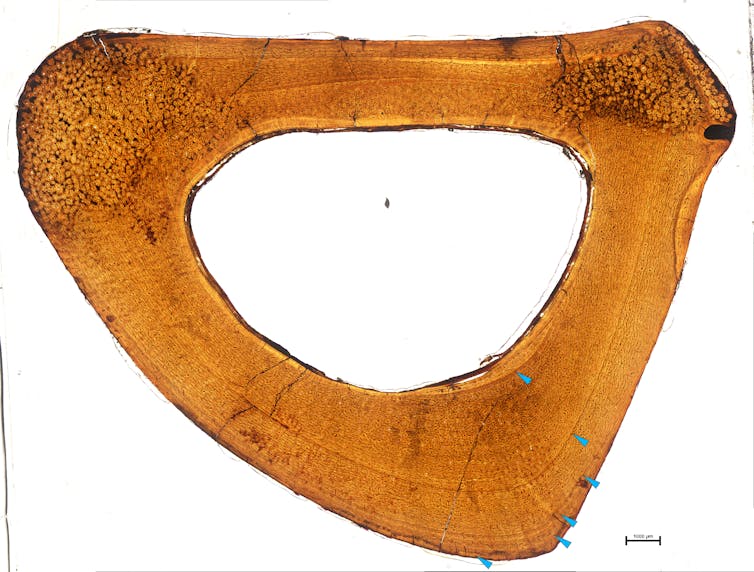
And they do this by looking at the spacing of growth rings in the animals bones. If it was a juvenile the rings would be wide - rapid growth. But this animal has closely spaced growth rings indicating it was an adult. 

It had been classified as a juvenile "chicken from hell" Eoneophron anzu. (I think that is the official name of the larger beastie - the article is not very clear on this.) It has been given the name Eoneophron infernalis. 

So new species were evolving right up to the time of the impact.


Teal markers point to lines of arrested growth on the cross-section of fossilized bone. Toward the outside of the bone, the lines are much closer together, reflecting less growth per year. Researchers counted exactly six lines, meaning this animal was between 6 and 7 years old when it died. Holly Woodward


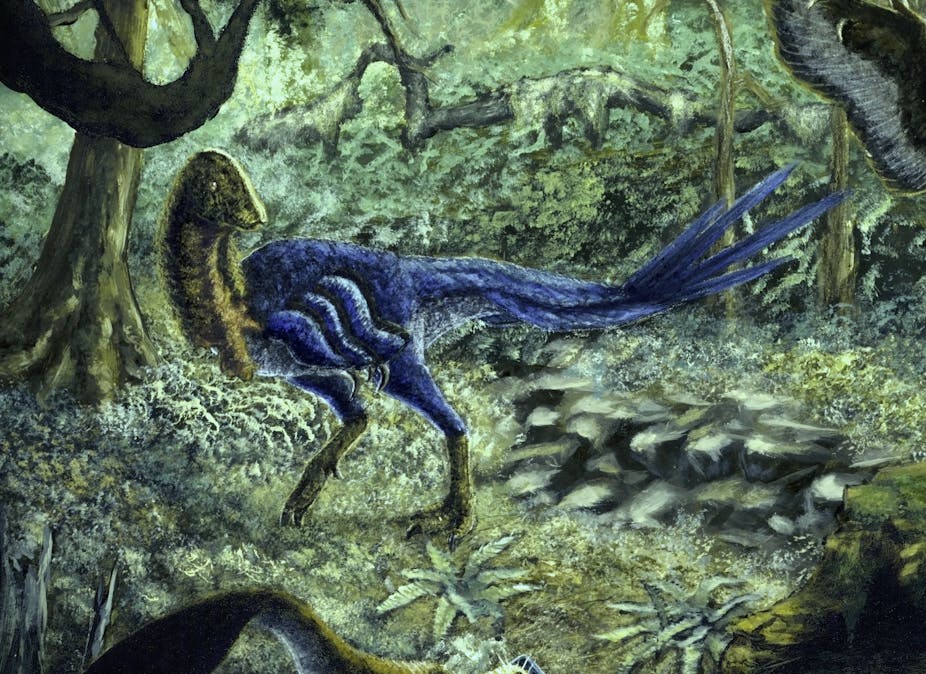
And here is a picture of the animal itself.


Birdlike dinosaur Eoneophron infernalis was about the size of an adult human. Zubin Erik Dutta

Saturday, 20 January 2024

I Won't Live Forever Because of the Dinosaurs!

 I Won't Live Forever Because of the Dinosaurs!

Mammals were at the bottom of the food chain when dinosaurs were the top predators and therefore to survive mammals became small, nocturnal and short-lived. They had to reproduce rapidly and did not need processes and genes related to long life such as repair and regeneration.

The same cannot be said for reptiles, amphibians and fish. They die from being eaten, not from old age! Many of these continue to reproduce throughout their lives.

I read about this fascinating subject in THIS ARTICLE. 

Saturday, 6 January 2024

Dolomite - Solved?

Dolomite - Solved? 

Many old rocks are dolomite, younger ones are seldom dolomite - why? 

There has been some activity in the dolomite field which shows that you can grow dolomite in the laboratory relatively quickly by repeatedly washing the growing crystal. 

(Dolomite crystals have layers of calcium, carbonate, magnesium, endlessly repeated. In the rocks there is no magnesium in the calcium layers and no calcium in the magnesium layers. Up to now this was impossible to replicate in the laboratory.)

The original paper which tells how to make dolomite is HERE. And "popular" readings of the paper are HERE and HERE and lots of other places.

This is very interesting but I am not sure that it tells us why dolomite is not being made in nature now.

Another annoyance is that the popular papers are obvious copies of each other - they all tell us that the White Cliffs of Dover are dolomite. At least that is not in the original.


Down to Earth Extra January 2024

 Down to Earth Extra January 2024

The December 2023 edition of Down to Earth Extra has been published. You can download it HERE or you can read it below.