Saturday, 13 April 2019

Reg Bradshaw - Obituary

Reg Bradshaw - Obituary

Richard F. J. Arthur has sent this.

Reginald Bradshaw PhD MSc FGS
 1924 – 2019


Reg Bradshaw was a highly respected geologist with a long and distinguished career which began in 1948 at UCL.  In 1958 he moved to Bristol University’s Geology Department.  There he obtained a doctorate and became a senior member of staff, writing numerous scientific papers.   A full account is being written elsewhere so I will restrict this to a personal tribute and to his connection with BNS and WEGA. 

Reg was my tutor at Bristol, and was inspirational in developing my passion for geology and interest in education.  He was kind and considerate, very approachable, and consequently he was popular with students and staff.  Like many others, I only ever knew him as Reg. 

Always the well dressed elder statesman (usually in a tweed jacket) but with the energy of a teenager and a dry sense of humor and, confirmed by his family, a slightly mischievous character. That boundless energy, enthusiasm for life and twinkle in his eye, never left him.

The current Prof, Mike Benton, told me that Reg was before his time but wrote “I met Reg a few times and was most impressed by his activity especially when we had our Adult education programmes”. 

Reg felt the University should be a nurturing environment and a community, and not just a seat of excellence. He also saw the value of taking geology to a much wider audience, and like many of the Geology Department staff he was a regular at meetings of the Bristol Naturalists Society and wrote many papers for the BNS proceedings. He was very active in BNS and joined a long list of presidents who, right from the societies foundation in 1862, were also geologists.

In addition to his research and teaching load, he took many extramural courses and field trips.  When these became ever popular, a regional branch of the Geologists Association (WEGA) was set up in 1976 – As I write this Reg is still listed as their President.  The then Prof - David Dinley (unable to be at the funeral through lack of mobility) give permission for WEGA to join BNS in being able to use departmental lecture theatres – thus both societies have longstanding links to the University and continue to utilise rooms for meetings –  Sadly in the current economic atmosphere it does not seem possible for the university to support any extramural geology courses.

Reg’s spent a lot of time in Norway and Connemara on his main research interest - metamorphism and crystallography.  However, he was very much from a generation of scientists who also saw the need to study geology as a whole and not in overly specialised compartments.  Some 25 years ago, he chaired a conference ‘earth science takes over from geology’ where he seemed to back my belief that such changes would not necessarily be for the better. 

Reg helped me choose my independent mapping area and when the metamorphic rocks turned out to be fiendishly complex, allowed me to simplify the petrology concentrating on the structural relationships instead.  Little did I realise then how much this would turn out to be due to the new fangled Plate Tectonics.  Back then students made their own thin sections and did a lot of field work, something Reg believed was essential to make a proper geologist.  

He was also a great help in my early career and I felt he was the good friend I could always turn to for help. On my frequent returns to the department after graduating in 1975 he always made me feel very welcome.   He facilitated access to the departmental library in the days when reference books were vital. Now in these days of turning to dubious IT such as Wikipedia they still are!   Reg embraced technology, and even back in the early 1970’s I was told that the Geology Department was the main user of the mainframe computer, which then took up a whole building - undoubtedly his research required a lot of number crunching.

Reg was an absolute whizz with the polarizing microscope, which he tried to teach me to use. I found it fascinating but hard not to be distracted by the pleasing play of colours.  He was also from a time when geology maps were beautifully coloured.  He helped me to be able to interpret them in 4 dimensions using the consistent logical colour scheme, evolved from William Smith’s map.  So when the department was changing over to the modern ugly and illogically coloured versions, Reg asked if I would like some, needless to say I still display them.

Reg enjoyed a long active retirement where he became a key figure in the local community and his church.  He was still street collecting for charity in his 90’s.  At the funeral, his colleague Brian Williams told us, that when the university was trying to decide which of two new members of staff to employ, Reg and another senior member of staff, Doug Hamilton decided to go part time so that both could be taken on. Due to this generosity Derek Briggs and a fellow graduate of my year Paul Wright joined the department, incidentally both are now professors.  Paul told me he was sad to be abroad as he really wanted to attend the funeral. Brian Williams and Doug Robinson together then talked fondly of the trips they went on with Reg, but also hinted at a series of stories about his more playful side! Other fellow member of staff present included Bernard Leake, David Speedyman, Liz Loeffler and Dave Roberts. The church was full with family and friends, colleagues and past students - all all of whom sung his praises, saying how much they liked and respected him.

I discovered from his son that Reg had been taken into Hospital but it was not a serious problem, so it was a tremendous shock when I was told Reg had contracted an infection and died peacefully just a few days after being admitted. 

A great loss to friends, family and to geology.

Richard F J Arthur.

Did Global Glaciation Cause the Great Unconformity?

Did Global Glaciation Cause the Great Unconformity?

This Article follows on from the the postulation of Snowball (or Slushball) Earth, to speculate about the consequences of having so much ice - erosion on a grand scale. 

At the end of the Proterozoic there are unconformities in many parts of the world. In North America one can see this unconformity in the Grand Canyon, where it is known as the Great Unconformity.

My photo of the Grand Canyon showing unconformity between the Pre-Cambrian (here Vishnu Schist) and the overlying sediments.

The authors estimate that 1.6 km was eroded from all the Earths land masses on average. Eventually this material will be subducted and therefore disappear - except for zircons!

To decide whether zircons came from the crust or the mantle the authors look at two isotopes of hafnium. And decide that at the start of the Neo-Proterozoic the proportion of crustal origin zircons increased.

There is much more in the article which is well worth reading. The source article is HERE

Friday, 5 April 2019

8th to 14th April 2019


NEXT WEEKS EVENTS

8th to 14th April 2019

THE FOLLOWING IS AN EXTRACT FROM BRISTOL AND WEST COUNTRY GEOLOGY CALENDARS

MORE DETAILS CAN BE FOUND IN THE BRISTOL AND THE WEST COUNTRY CALENDARS AND ON THE WEB SITES OF THE RELEVANT SOCIETY OR ORGANISATION.


MONDAY 8th


TUESDAY 9th

Cardiff University Lecture - When Sea levels Change...
When
Tue, 9 April, 18:30 – 20:00
Where
The 2018-2019 monthly Tuesday evening lectures in the School of Earth and Ocean Sciences will be held in the Wallace Lecture Theatre (0.13), Main Building, Cardiff University, Park Place, CF10 3AT. Lectures begin at 18.30. Booking is not needed. (map)
Description
When the sea-level rises… the UK villages lost to the sea.
Claire Earlie (Caerdydd/Cardiff)

WEDNESDAY 10th

DGAG Lecture - The deep structure beneath the Dorset region
When
Wed, 10 April, 19:00 – 21:00
Where
Dorset County Hall, Colliton Park, Dorchester, Dorset, DT1 1XJ, United Kingdom (map)
Description
Using seismic lines, gravity, magnetics, boreholes and pure conjecture to re-construct the history from the Lower Paleozoic to the Triassic. 

Talk by Dr Malcolm Butler. 

This continues the series of Earth Science-based lectures organised by DGAG in collaboration with other groups. 
As the Dorset County Museum is closed for refurbishment, ’til summer 2020,  the lectures will take place in Committee Room 1 at County Hall. They will follow the familiar pattern of being on the second Wednesday of the month starting at 7 pm. 
Parking is available behind County Hall and is free in the evening. 

Malcolm Butler holds a BSc in geology from Aberystwyth and a PhD from Bristol.  He has had a 45-year career as an explorationist and senior executive in a range of oil and gas exploration companies, working in most parts of the World. For the past 30 years he has acted as CEO or Chairman of various small to medium-sized oil companies in North America and the UK and has also spent time as a senior investment banking advisor.  In 1994, he was founding Chairman of the UK Onshore Geophysical Library, a position he still holds, and he has played a major role in the growth and success of this organization
and its academic arm "Beneath Britain" at Oxford. He is also Chairman and CEO of AIM- listed Baron Oil Plc and Executive Director of privately-owned Corfe Energy Limited.

Since joining the oil industry, he has published on Buchan Field, Gulf of Suez geology and a number of papers on the subsurface geology of the Weald Basin, Wessex Basin and the Midlands Microcraton. He was awarded the Aberconway Medal of the Geological Society in 1994 and was appointed an Honorary Professor at Aberystwyth in
1996.

THURSDAY 11th


Friday 12th

Cheltenham Mineral and Geological Society - Lecture
When
Fri, 12 April, 19:00 – 21:00
Where
Shurdington at The Century Hall (map)
Description
' Adamas---- A very special rock  '  about the Millennium Diamond

                               Our guest speaker is       Tim Thorn

Saturday 14th

OUGS Wessex - Weekend Field Trip
When
13 – 14 Apr 2019
Where
Yarmouth, Isle of Wight (map)
Description
Geology of the Isle of Wight


Leader: Dr Steve Sweetman

Location: Yarmouth, Isle of Wight

Date: April 13th–14th, 2019

Type: Field Trip (Weekend)

Summary: Two full days in the field in this geologically rich and attractive coastal location, guided by a local geologist who is an expert in the fossils and sedimentary geology of the early Cretaceous Wessex Formation.

More info:

This trip is open to residential and day attendees. It promises stratigraphy, fossils, tectonic deformation, and stunning coastal views. The itinerary is provisional, but we hope to spend Saturday on the south-west coast examining the Cretaceous fluvial and lagoon deposits that have yielded the dinosaur fossils for which the Isle of Wight is famous. On Sunday, we expect to visit Alum Bay where the mainly vertical dipping strata reveal the 'most extensive and complete succession of the Paleogene available in the UK'. 

For accommodation and day attendee options, please see IOW_2019_Information_Sheet.pdf

We need ten confirmed expressions of interest by Wednesday 7 January 2019 to confirm that this trip is viable. 


Contact: Chris Hawkes  [chris.ougswsx@outlook.com]
--------------------------------------

OUGS Severnside - Excursion
When
Saturday, 13 Apr 2019
Where
Woolhope, near Hereford, Herefordshire (map)
Description
Geology of the Woolhope Dome
Leader: Dave Green
Location: Woolhope, near Hereford, Herefordshire
Date: April 13th 2019 (Saturday)
Type: Field Trip (Day)
Summary: A golden opportunity to explore the Woolhope Dome inlier, an upland area of folded Silurian rocks.
More info:
Now confirmed for Saturday 13th April.

This will be a golden opportunity to explore the famous Woolhope Dome inlier, an upland area of folded Silurian rocks near Hereford that have been exposed by the erosion of younger Old Red Sandstone.

We will meet at the small village of Woolhope, in the centre of the Woolhope Dome inlier.

In the morning we will be able to see and study virtually all the main Wenlock, Ludlow and Pridoli rock units on the eastern side of the Woolhope Dome, and observe their effect on the landscape. This will entail a walk of about 3.5km, with a total ascent/descent of around 350 metres.

After lunch we will drive to three locations to investigate the Upper Llandovery sequence in the core of the dome. To end the day we will climb the small hill known to locals as "The Knob” to get a good overall view of the inlier from the south-west.

This area is difficult to access by car as the roads are narrow with few parking places, and car-sharing will organised when we initially meet at Woolhope village.

Please contact Michelle Thomas (details below) to book a place. 


Contact: Michelle Thomas (michellef-t@hotmail.co.uk)
----------------------------------------------

SWGA - Excursion
When
Sat, 13 April, 10:00 – 16:30
Where
Meet at 10.00am at Candleston Castle car park (SS 872 773), which is a Pay & Display car park (£3 all day). (map)
Description
Candleston, Newton and Merthyr Mawr; A geological ramble
Leader: Stephen Howe
Meet at 10.00am at Candleston Castle car park (SS 872 773), which is a Pay & Display car park (£3 all
day). Bring a packed lunch.
Having failed once again to find a field trip leader for April I am offering a circular 'walk with geology'
from Candleston Castle to Newton Burrows and back via Merthyr Mawr and the Ogmore estuary. We
will see various exposures as well as looking at how the underlying geology is expressed in the
landscape. The walk is approximately 8km (5 miles) long and apart from one small hill is relatively flat.
Much of the return from Newton Burrows is across the beach, saltmarsh and sand dunes

Sunday 15th


OUGS WESSEX - WEEKEND FIELD TRIP - see above

Tuesday, 2 April 2019

Is radon involved in volcanic lightning?

Volcanoes, Lightning -?Radon?

This article in the New York Times discusses the discovery that even an ash-less volcano like Stromboli has a substantial charge. It was thought that charges (and hence lightning) in a volcanic ash cloud was caused by the particles rubbing against each other. 

But balloons sent over Stromboli (by a Bristol University physicist) discovered electrical charges in its cloud. The source of the charge is thought to be the decay of radioactive radon!

By itself radon does not seem to cause lightning - no lightning at Stromboli - but more work will be done to examine its contribution.

An eruption of the Calbuco volcano in April 2015. Martin Bernetti/Agence France-Presse — Getty Images


Saturday, 30 March 2019

1st to 7th April 2019


NEXT WEEKS EVENTS

1st to 7th April 2019

THE FOLLOWING IS AN EXTRACT FROM BRISTOL AND WEST COUNTRY GEOLOGY CALENDARS

MORE DETAILS CAN BE FOUND IN THE BRISTOL AND THE WEST COUNTRY CALENDARS AND ON THE WEB SITES OF THE RELEVANT SOCIETY OR ORGANISATION.


MONDAY 1st


TUESDAY 2nd


WEDNESDAY 3rd


Thursday 4th

Bath Geol Soc - Lecture
When
Thu, 4 April, 19:30 – 21:00
Where
Bath Royal Literary and Scientific Institution, 16 Queen Square, Bath (map)
Description
Dr. James Verdon (Bristol)

The shale gas boom: A history of “fracking" from the 19th to the 21st centuries. 

 Abstract 
Hydraulic fracturing, or fracking, for shale gas has become an issue of significant public debate. In this talk I will chart the history of this often poorly-understood technology, from the original well-shooters of the 19th Century, through to modern-day shale gas developments. 

Friday 5th


Saturday 6th

SGMRG - Conference
When
Sat, 6 April, 09:30 – 16:00
Where
Saltford (map)
Description
South West Industrial Archaeology Conference - Saltford


Sunday 7th


North Dakotan evidence for Chicxulub impact

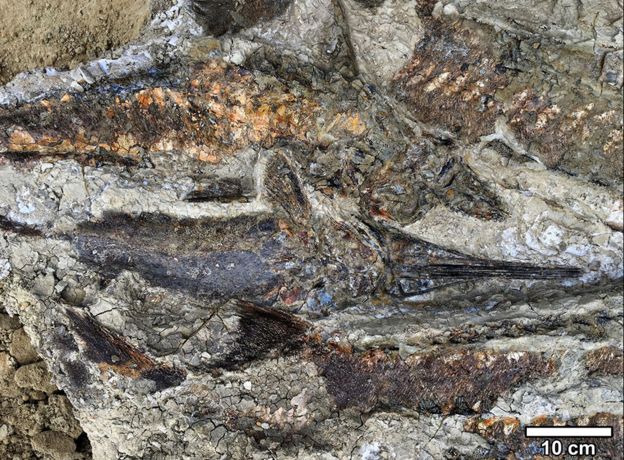
KP (or T) Impact Evidence in North Dakota


An informant has brought THIS to my attention.

The article describes what must have happened shortly after the impact event. 

Fossilised fish piled one atop the other as they were flung ashore.

When the asteroid impacted, billions of tons of molten rock was flung into the air. And some of it landed at Tanis, the site in North Dakota. Some is found in the gills of fish, some in amber - resin at the time.

The site shows signs of water inundation, possibly caused by a tsunami, more probably by a seiche - water displaced by a massive seismic shockwave.

I suspect we will be hearing more of this site in the future.

Two Field Courses with Nick Chidlaw

Two Field Courses with Nick Chidlaw

Sandhurst Hill north of Gloucester

Nick Chidlaw has sent me the following:- 


July 2019 – Severn Vale north of Gloucester and escarpment of the mid Cotswolds

Two 1-day field courses. These are independent of each other – enrolment can be on either, or both courses, according to interests / availability. 
Tutor: Dr Nick Chidlaw
Saturday 20th and Sunday 21st July 2019
10.00 am – 5.00 pm each day
ICE AGE & HOT DESERT: TWO GEOLOGICAL WALKS NEAR GLOUCESTER Saturday 20th July
The Severn Valley immediately north of Gloucester comprises a rural landscape of farmland and scattered villages, punctuated by abrupt, flat-topped hills, and extensive tracts of valley floor over which the tidal rivers flows south. The geological history of the area is fascinating and contrasting. The oldest strata, c. 200 million year old, were laid down in hot deserts which gave way to shallow tropical seas; they can be seen in a cliff along the river. The hill tops preserve glacial deposits, and on the valley sides below is found a legacy of past valley floors now remaining as a series of ‘terraces’, as the river progressively incised its course. These hill top and terrace deposits were laid down during the Ice Age of recent geological time. Towards the end of the last glaciation, the river here was flowing in a ravine below its present level. With the ending of the Ice Age some 10,000 year ago, and the associated rise in sea level, the river has built up its broad clayey plain, frequently prone to hazardous winter floods. This course comprises a morning walk (c. 4 miles) and an afternoon walk (c. 3 miles), both gently-paced with frequent stops to discuss the geology and landforms.
A GEOLOGICAL WALK IN ESCARPMENT COUNTRY, MID COTSWOLDS: Jurassic strata and landforms near and far Sunday 21st July 
The steep escarpment of Jurassic rocks in the mid Cotswolds looks north-west across the broad low-lying Severn Vale, to the Welsh Borderland hills and beyond. This mainly rural, highly attractive landscape overlies a geological legacy of repeated tectonic plate collision and extension, uplift and erosion, going back to Precambrian times. On this course you can learn to recognise these landforms, know of their underlying geology and understand how both came into being. Walking c. 4 miles between Doverow Hill near Stonehouse across the valley of the River Frome to Selsley Common, we examine exposures of Early and Middle Jurassic strata in old quarries and pits, and lane cuttings. These rocks, many of which are highly fossiliferous, were laid down in warm tropical seas overlying an active rift complex. In the Ice Age of recent geological times, the River Severn and its tributaries progressively incised their courses, and landslides occurred on the escarpment as it came into being; these landslides continued to take place, notably at the end of the last cold climatic episode c. 10,000 year ago, with some local movement continuing today.    
Attached photograph is of Sandhurst Hill  near Gloucester: this flat-topped hill (88m OD) has a veneer of glacial till and associated outwash deposits, laid down by a glacier during the Anglian Glaciation (480,000 – 420,000 years ago). Sandhurst Hill is a remnant of what was the valley floor of the Severn Vale at that time, since deepened by erosion to its present level.  
No prior knowledge of geology, or the areas to be studied, is assumed. Attendees arrange their own travel, and if they do not live locally, arrange their own meals and accommodation – tutor can advise.
Meeting locations provided to those enrolled.
Volunteer drivers will be needed to facilitate the planned walking on both courses – please indicate if you would be willing to be a volunteer driver when enrolling
Tuition fee £27.00 per person per course.
If you/ anyone else you know would like to attend either or both these courses, please forward cheque payable to me to:
Dr N Chidlaw
8, Silver Street,
Dursley,
Glos.
GL11 4ND
Bank trans can be arranged if you do not use cheques – let me know.
Please provide me with your postal address – I will then be able to send you your course handout(s) in good time before the courses run, should they become viable.
Deadline for minimum number (10) of enrolments for both courses is Saturday 18th May. Maximum number of enrolments is 30. If the minimum of enrolments for either or both courses is reached by this deadline, arrangements will continue; if not, the course / courses will be cancelled and fees received will be returned soon afterwards to those who have sent them in. Once viable, enrolments on the course can continue up to 1 week before they are due to run (Saturday 13th July)   
Any queries, contact tutor nickchidlaw@gmail.com