Friday, 29 November 2019


An interesting blog
An Interesting Blog
A correspondent has brought THIS BLOG to my notice. It is what this blog would look like if I had Steve Drury's talent and intellect! I would recommend it to everyone. But keep on reading this one!

Wednesday, 27 November 2019
Continents - Lost and Found
Continents - Lost and Found
THIS ARTICLE reviews what we know, and do not know, about lost continents, mostly under the sea but also squished up in mountain chains.
Their main focus is on the lost continents around Australia, including the Louisiade Plateau which has been the subject of their current research.
But they also give a good background to the subject and the article is well worth reading.
Their main focus is on the lost continents around Australia, including the Louisiade Plateau which has been the subject of their current research.
But they also give a good background to the subject and the article is well worth reading.
Saturday, 23 November 2019
25th November to 1st December 2019
NEXT WEEKS EVENTS
25th November to 1st December 2019
NEXT WEEKS EVENTS
THE FOLLOWING IS AN EXTRACT FROM BRISTOL AND WEST COUNTRY GEOLOGY CALENDARS
MORE DETAILS CAN BE FOUND IN THE BRISTOL AND THE WEST COUNTRY CALENDARS AND ON THE WEB SITES OF THE RELEVANT SOCIETY OR ORGANISATION.
MONDAY 25TH
Geostudies - Lecture Series - Ordovician
When
Mon, 25 November, 19:30 – 21:30
Where
Wynstones School, Stroud Road, Whaddon, Gloucester (map)
Description
Geology of the Ordovician Period.
The last Phanerozoic geological period to be named, after a bitter struggle between Murchison and Sedgwick. Lasting from
485 to 444Ma ago, this period saw the enormous radiation of new forms of life and the earliest colonisation of the land by primitive plants “The Great Ordovician Biodiversification Event” . The two halves of Britain were separated by the Iapetus Ocean, but both were tectonically extremely active. The supercontinent of Gondwana drifted across the South Pole, possibly triggering a short and unusual (high CO2) glaciation and the second biggest mass extinction of life at the end of the period. As usual there is considerable debate about aspects of this period.
Starts Mon 16th September for 10 weeks (not 28th Oct nor 4th Nov nor 2nd Dec), until 9th December Held at Wynstones School, Stroud Road, Whaddon, Gloucester from 7.30-9.30pm on Mondays.
Cost £75 (including tea, coffee etc at break time!).
Tuesday 26th
Wednesday 27th
Bristol Nats Lecture
When
Wed, 27 November, 19:30 – 21:00
Where
Westbury-on-Trym Methodist Church, Westbury Hill, Bristol, BS9 3AA (map)
Description
William Sanders – First President of Bristol Naturalists Society
Talk by Deborah Hutchinson – Bristol City Museum
This talk, which will be of interest to all BNS members, will focus on his life and contributions to science and in particular the production of his map of the Bristol Coal Field that forms the basis of the BNS study area today.
thursday 28th
Geostudies - Lecture Series - Miscellany
When
Thu, 28 November, 18:30 – 20:30
Where
John Kyrle High School, Ledbury Rd, Ross-on-Wye HR9 7ET, UK (map)
Description
Understanding the Earth – a Geological Miscellany
Thursday September 19th, 6.30-8.30pm, running for 10 weeks at the Adult Education Centre, John Kyrle High School until 12th December (missing out 24th, 31st October and 7th November) covering the following topics: Geological maps and structures, and their relationship to landscape development; Tectonics, mountain building and their effects on landforms; Geological resources – formation , occurrence and exploitation; Climate change in a geological context.
Cost £75, including drinks at break time.
------------------------------------
Talk in Wells
When
Thu, 28 November, 19:00 – 20:30
Where
Cedars Hall, Wells Cathedral School (map)
Description
Talk: Somerset’s Beastly Past
Ice Age Climates and Changing Fauna
Danielle Schreve, Professor Of Quaternary Science, Royal Holloway University, tells us about the fascinating insights into animal responses to abrupt climate change at the end of the last Ice Age.
Tickets: £8 unreserved, free for 25s and under
Book your tickets http://cedarshall.events box office: 01749 834483
friday 29th
Geostudies - Field Course - Lake district
When
29 Nov – 2 Dec 2019
Where
Lake District (map)
Description
Geology of the Lake District
A classic area for the study of the folded Lower Palaeozoic basement in the Central Lakes, and the unconformable Carboniferous, Permian and Triassic sequence exposed around its margins. Spectacular scenery, classic sedimentary, volcanic, structural and metamorphic geology, and a wide variety of mineralisation.
Friday lunchtime to Monday lunchtime.
saturday 30th
GEOSTUDIES - FIELD COURSE - LAKE DISTRICT - see Friday
SUNDAY 1st
GEOSTUDIES - FIELD COURSE - LAKE DISTRICT - see Friday
Geostudies - Lecture Series - Ordovician
When
Mon, 25 November, 19:30 – 21:30
Where
Wynstones School, Stroud Road, Whaddon, Gloucester (map)
Description
Geology of the Ordovician Period.
The last Phanerozoic geological period to be named, after a bitter struggle between Murchison and Sedgwick. Lasting from
485 to 444Ma ago, this period saw the enormous radiation of new forms of life and the earliest colonisation of the land by primitive plants “The Great Ordovician Biodiversification Event” . The two halves of Britain were separated by the Iapetus Ocean, but both were tectonically extremely active. The supercontinent of Gondwana drifted across the South Pole, possibly triggering a short and unusual (high CO2) glaciation and the second biggest mass extinction of life at the end of the period. As usual there is considerable debate about aspects of this period.
Starts Mon 16th September for 10 weeks (not 28th Oct nor 4th Nov nor 2nd Dec), until 9th December Held at Wynstones School, Stroud Road, Whaddon, Gloucester from 7.30-9.30pm on Mondays.
Cost £75 (including tea, coffee etc at break time!).
Bristol Nats Lecture
When
Wed, 27 November, 19:30 – 21:00
Where
Westbury-on-Trym Methodist Church, Westbury Hill, Bristol, BS9 3AA (map)
Description
William Sanders – First President of Bristol Naturalists Society
Talk by Deborah Hutchinson – Bristol City Museum
This talk, which will be of interest to all BNS members, will focus on his life and contributions to science and in particular the production of his map of the Bristol Coal Field that forms the basis of the BNS study area today.
Geostudies - Lecture Series - Miscellany
When
Thu, 28 November, 18:30 – 20:30
Where
John Kyrle High School, Ledbury Rd, Ross-on-Wye HR9 7ET, UK (map)
Description
Understanding the Earth – a Geological Miscellany
Thursday September 19th, 6.30-8.30pm, running for 10 weeks at the Adult Education Centre, John Kyrle High School until 12th December (missing out 24th, 31st October and 7th November) covering the following topics: Geological maps and structures, and their relationship to landscape development; Tectonics, mountain building and their effects on landforms; Geological resources – formation , occurrence and exploitation; Climate change in a geological context.
Cost £75, including drinks at break time.
------------------------------------
Talk in Wells
When
Thu, 28 November, 19:00 – 20:30
Where
Cedars Hall, Wells Cathedral School (map)
Description
Talk: Somerset’s Beastly Past
Ice Age Climates and Changing Fauna
Danielle Schreve, Professor Of Quaternary Science, Royal Holloway University, tells us about the fascinating insights into animal responses to abrupt climate change at the end of the last Ice Age.
Tickets: £8 unreserved, free for 25s and under
Book your tickets http://cedarshall.events box office: 01749 834483
Geostudies - Field Course - Lake district
When
29 Nov – 2 Dec 2019
Where
Lake District (map)
Description
Geology of the Lake District
A classic area for the study of the folded Lower Palaeozoic basement in the Central Lakes, and the unconformable Carboniferous, Permian and Triassic sequence exposed around its margins. Spectacular scenery, classic sedimentary, volcanic, structural and metamorphic geology, and a wide variety of mineralisation.
Friday lunchtime to Monday lunchtime.
Somerset's Beastly Past
TALK IN WELLS - SOMERSET'S BEASTLY PAST
A correspondent has asked me to remind you of an interesting lecture at Wells Cathedral School. Details below.

Saturday, 16 November 2019
18th to 24th November 2019
NEXT WEEKS EVENTS
18th to 24th November 2019
NEXT WEEKS EVENTS
THE FOLLOWING IS AN EXTRACT FROM BRISTOL AND WEST COUNTRY GEOLOGY CALENDARS
MORE DETAILS CAN BE FOUND IN THE BRISTOL AND THE WEST COUNTRY CALENDARS AND ON THE WEB SITES OF THE RELEVANT SOCIETY OR ORGANISATION.
MONDAY 18TH
Geostudies - Lecture Series - Ordovician
When
Mon, 18 November, 19:30 – 21:30
Where
Wynstones School, Stroud Road, Whaddon, Gloucester (map)
Description
Geology of the Ordovician Period.
The last Phanerozoic geological period to be named, after a bitter struggle between Murchison and Sedgwick. Lasting from
485 to 444Ma ago, this period saw the enormous radiation of new forms of life and the earliest colonisation of the land by primitive plants “The Great Ordovician Biodiversification Event” . The two halves of Britain were separated by the Iapetus Ocean, but both were tectonically extremely active. The supercontinent of Gondwana drifted across the South Pole, possibly triggering a short and unusual (high CO2) glaciation and the second biggest mass extinction of life at the end of the period. As usual there is considerable debate about aspects of this period.
Starts Mon 16th September for 10 weeks (not 28th Oct nor 4th Nov nor 2nd Dec), until 9th December Held at Wynstones School, Stroud Road, Whaddon, Gloucester from 7.30-9.30pm on Mondays.
Cost £75 (including tea, coffee etc at break time!).
Tuesday 19th
Geol Soc Western - Lecture
When
Tue, 19 November, 18:00 – 19:30
Where
The Hub, 500 Park Ave, Aztec W, Almondsbury, Bristol BS32 4RZ, UK (map)
Description
Asbestos - TBC
--------------------------------
SMFS Evening Meeting
When
Tue, 19 November, 19:30 – 21:30
Where
The Friends' Meeting House, 1A, Ordnance Rd, Southampton. SO15 2AZ (map)
Description
“The Skye Meteorite” – presentation by Dr Simon Drake & Dr Andy Beard, Birkbeck, University of London.
Members’ Display Table: Minerals and rocks from outer space!
Details at http://www.sotonminfoss.org.uk/smfsprog.htm
Wednesday 20th
Thursday 21st
Geostudies - Lecture Series - Miscellany
When
Thu, 21 November, 18:30 – 20:30
Where
John Kyrle High School, Ledbury Rd, Ross-on-Wye HR9 7ET, UK (map)
Description
Understanding the Earth – a Geological Miscellany
Thursday September 19th, 6.30-8.30pm, running for 10 weeks at the Adult Education Centre, John Kyrle High School until 12th December (missing out 24th, 31st October and 7th November) covering the following topics: Geological maps and structures, and their relationship to landscape development; Tectonics, mountain building and their effects on landforms; Geological resources – formation , occurrence and exploitation; Climate change in a geological context.
Cost £75, including drinks at break time.
------------------------------
Thornbury Geology Group, 7.30pm, The Chantry, Thornbury
When
Thu, 21 November, 19:00 – 21:30
Description
Thornbury Geology Group, 7.30pm at The Chantry, Thornbury, and every 3rd Thursday in the month.
Friday 22nd
Saturday 23rd
Sunday 24th
Oxford Mineral & Fossil Show
When
Sun, 24 November, 10:00 – 16:00
Where
Exeter Hall, Kidlington, OX5 1AB (map)
Geostudies - Lecture Series - Ordovician
When
Mon, 18 November, 19:30 – 21:30
Where
Wynstones School, Stroud Road, Whaddon, Gloucester (map)
Description
Geology of the Ordovician Period.
The last Phanerozoic geological period to be named, after a bitter struggle between Murchison and Sedgwick. Lasting from
485 to 444Ma ago, this period saw the enormous radiation of new forms of life and the earliest colonisation of the land by primitive plants “The Great Ordovician Biodiversification Event” . The two halves of Britain were separated by the Iapetus Ocean, but both were tectonically extremely active. The supercontinent of Gondwana drifted across the South Pole, possibly triggering a short and unusual (high CO2) glaciation and the second biggest mass extinction of life at the end of the period. As usual there is considerable debate about aspects of this period.
Starts Mon 16th September for 10 weeks (not 28th Oct nor 4th Nov nor 2nd Dec), until 9th December Held at Wynstones School, Stroud Road, Whaddon, Gloucester from 7.30-9.30pm on Mondays.
Cost £75 (including tea, coffee etc at break time!).
Geol Soc Western - Lecture
When
Tue, 19 November, 18:00 – 19:30
Where
The Hub, 500 Park Ave, Aztec W, Almondsbury, Bristol BS32 4RZ, UK (map)
Description
Asbestos - TBC
--------------------------------
SMFS Evening Meeting
When
Tue, 19 November, 19:30 – 21:30
Where
The Friends' Meeting House, 1A, Ordnance Rd, Southampton. SO15 2AZ (map)
Description
“The Skye Meteorite” – presentation by Dr Simon Drake & Dr Andy Beard, Birkbeck, University of London.
Members’ Display Table: Minerals and rocks from outer space!
Details at http://www.sotonminfoss.org.uk/smfsprog.htm
Geostudies - Lecture Series - Miscellany
When
Thu, 21 November, 18:30 – 20:30
Where
John Kyrle High School, Ledbury Rd, Ross-on-Wye HR9 7ET, UK (map)
Description
Understanding the Earth – a Geological Miscellany
Thursday September 19th, 6.30-8.30pm, running for 10 weeks at the Adult Education Centre, John Kyrle High School until 12th December (missing out 24th, 31st October and 7th November) covering the following topics: Geological maps and structures, and their relationship to landscape development; Tectonics, mountain building and their effects on landforms; Geological resources – formation , occurrence and exploitation; Climate change in a geological context.
Cost £75, including drinks at break time.
------------------------------
Thornbury Geology Group, 7.30pm, The Chantry, Thornbury
When
Thu, 21 November, 19:00 – 21:30
Description
Thornbury Geology Group, 7.30pm at The Chantry, Thornbury, and every 3rd Thursday in the month.
Oxford Mineral & Fossil Show
When
Sun, 24 November, 10:00 – 16:00
Where
Exeter Hall, Kidlington, OX5 1AB (map)
Tuesday, 12 November 2019
The Tully Monster
The Tully Monster
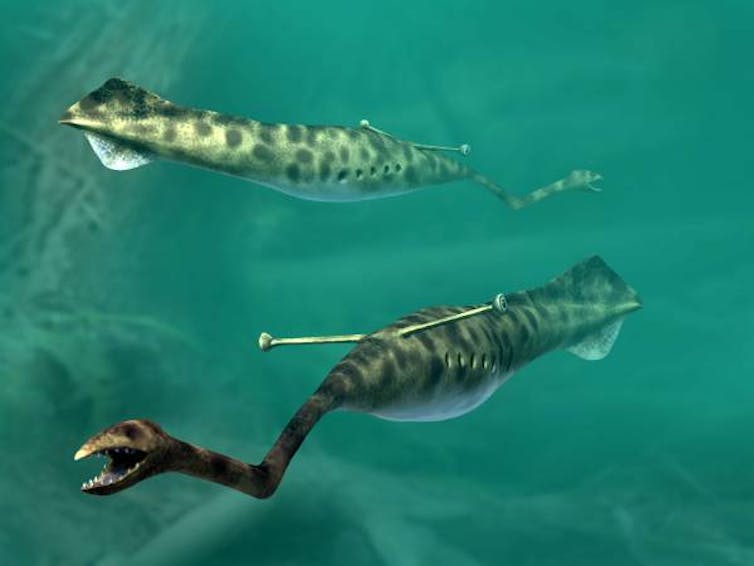
Nobody knows what the Tully Monster was. Consequently it is the State Fossil of Illinois, the state in which it was discovered by Francis Tully in the 1950's. It lived about 300m years ago.
Is it a vertebrate or an invertebrate? The answer may lie in its (very odd) eyes! Did you know that there was zinc and copper in eyes and their ratio differs between creatures with backbones and those without.
You can read all about it in THIS ARTICLE. The reconstructions certainly look odd!
Subscribe to:
Posts (Atom)