Tuesday, 21 July 2020

More About "Can Rock Weathering Halt Global Warming?"

More About "Can Rock Weathering Halt Global Warming?"


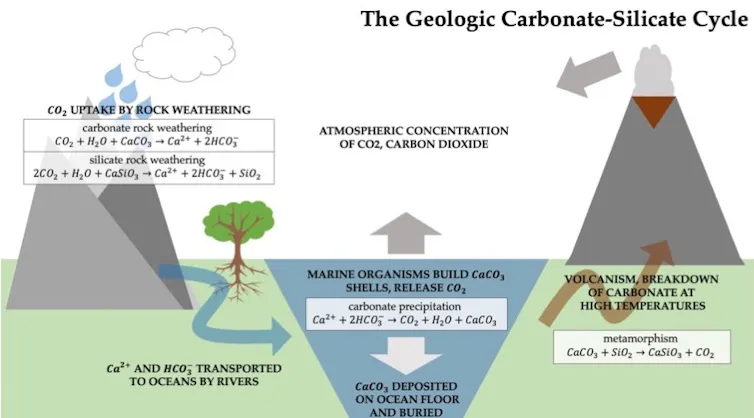
HERE is some more information on this topic and a new diagram on the carbonate-silicate cycle.

When carbonic acid dissolves calcium and magnesium silicate minerals, they break down into dissolved compounds, some of which contain carbon. These materials can flow to the ocean, where marine organisms use them to build shells. Later the shells are buried in ocean sediments. Volcanic activity releases some carbon back to the atmosphere, but much of it stays buried in rock for millions of years. 

Gretashum/Wikipedia, CC BY-SA


Wednesday, 15 July 2020

Can Rock Weathering Halt Global Warming?

Can Rock Weathering Halt Global Warming?

This question has appeared in the news lately. THIS ARTICLE gives a good overview of the chemistry involved. And it can be summarised in the diagram below.


The author is properly sceptical, pointing out the difficulties of getting finely ground basalt onto farmer's fields. But he is not dismissive.

Friday, 10 July 2020

The Universe in X-rays

The Universe in X-rays

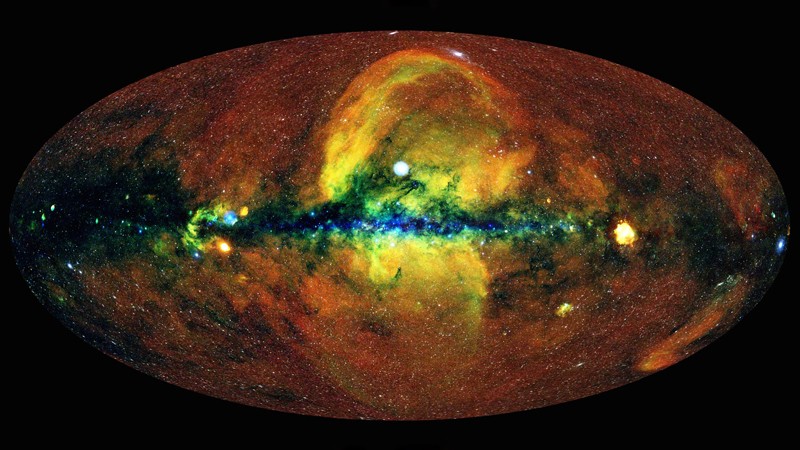
Not particularly geologic but still important - HERE is a X-ray map of the universe. Many thanks to a correspondent for sending me the link.


Tuesday, 7 July 2020

GA now on Youtube

GA now on Youtube

You can find it HERE. So far it is videos of presentations at GA conferences. 

I liked THIS ONE on salt tectonics. One quibble - when she uses her optical pointer I cannot see what she is pointing at! Usually you can work out what it is , but not always. But still well worth looking at.


Thursday, 2 July 2020

Tomotectonic Analysis of Western North America

Tomotectonic Analysis of Western North America

This is the first time I have come across this term. It means a tectonic plate reconstruction using both mantle and geological evidence. 

The paper which introduced me to the term has not yet been published but a PDF form is available HERE. The amount of information used in this paper is phenomenal. And it shows when you look at the animation below. It is this which first attracted my attention. Watching the continents dance is always fun!

You can see a full size version on THIS PAGE. Scroll to the bottom, click on Supporting Information and the on either of the video files.


I have glanced at the paper and quickly realised that you need to be a specialist to criticise it. And that is not me!!! Enjoy the animation.

Wednesday, 1 July 2020

Mesozoic Insects Show Their True Colours

Mesozoic Insects Show Their True Colours

A correspondent sent me THIS LINK. It tells of some remarkably well preserved insects of mid-Cretaceous age. They have been found in amber, recovered from a mine in Burma. Not only have the forms of the insects been preserved but also their colours. 

The colours are structural colour, formed by fine structures on their bodies which are small enough to interfere with visible light. And it is likely that the colours we see are the same as the colours the insects had in life. The original article (and more pictures) can be found HERE.


It's the Asteroid That Did it!

It's the Asteroid That Did it!

From a twitter feed, a reader of this blog, Anthony Brook, produced THIS PDF file. It concerns a paper which looks at the causes of the K/Pg extinction event. (This was the K/T event in my youth.) Among the authors are two from Bristol's School of Geographical Sciences.

They discuss whether the Chicxulub asteroid or the Deccan traps were the culprit. They use climate modelling of a complexity which I can appreciate, if not understand.

The conclusion they reach is that Deccan volcanism would have led to cooling but have left enough equatorial habitats for dinosaur survival. Indeed the CO₂ produced by the volcanism would have mitigated the effects of solar dimming.

Asteroid impact, however, would be sufficient to remove all dinosaur friendly habitats. They suggest that the Deccan volcanism might have made things rather better! Global warming, due to CO₂, might be a good thing here!

Since the production of the twitter feed the actual publication has now emerged. You can get it HERE. Thanks to Anthony Brook for bringing this to my attention.


Geologic (A) and paleontological (B) records of the K/Pg mass extinction. Paleothermometer (A) showing the Deccan-induced warming with the two main episodes of volcanism highlighted by the black arrows and symbols of volcanoes. The last phase extends beyond the end of the Cretaceous, characterized by the bolide impact in Chicxulub. Fossil remains of non-avian dinosaurs (body fossils, egg fragments, and nesting sites) occur throughout the whole stratigraphic record of prolonged volcanism episodes (dinosaur silhouettes). Numbers represent upper Maastrichtian dinosaur bearing localities, mapped on a late Maastrichtian paleogeography in B. 1, Hell Creek Formation (United States); 2, Lameta Formation (India); 3, Tremp Formation (Spain); 4, Phosphorite beds (Morocco); 5, MarilĂ­a Formation (Brazil); 6, Nemegt Formation (Mongolia). Dinosaur silhouette image credit: Phylopic/Jack Mayer Wood, which is licensed under CC BY 3.0.